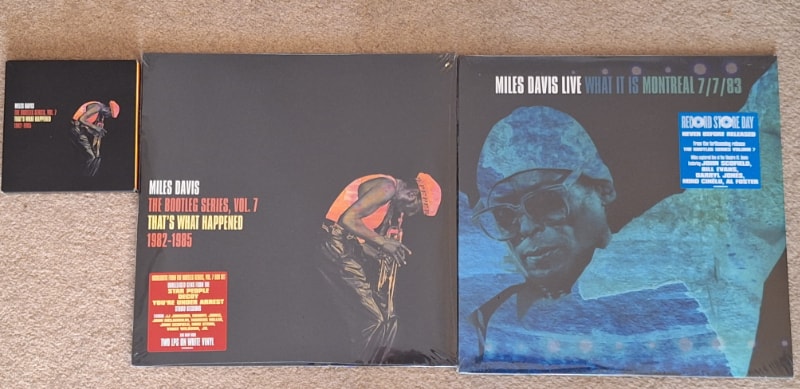
Bootleg Series 7 comes in two formats, a three-CD boxed set, and two albums, each a double LP. One contains highlights from the studio recordings, and the other, the complete 1983 Montreal concert.
Studio sessions: Miles Davis (trumpet, synthesiser, electric piano); Mike Stern, John Scofield, John McLaughlin (guitar); Bill Evans, Bob Berg (tenor sax, soprano sax); J.J. Johnson (trombone); Robert Irving III (keyboards); Marcus Miller, Darryl Jones (bass); Al Foster, Vince Wilburn Jr (drums); Mino Cinelu, Steve Thornton (percussion).
Live recording: Miles Davis (trumpet, synthesiser, electric piano); John Scofield (guitar); Bill Evans (tenor sax, soprano sax, flute); Darryl Jones (bass); Al Foster (drums), Mino Cinelu (percussion).
Recording dates: Studio recordings – Columbia Studios, NY, 20 October 1982; The Record Plant, NY, October 1982-January 1985; A&R Studio, NY, 30 June 1983. Live recordings – Théâtre St. Denis, Montreal, Canada, 7 July 1983.
For years, many fans of Miles’s 1980s music had been waiting for Sony Music (formerly Columbia Records) to open its music archives and release new Miles Davis material from this era. Their hopes were answered with the release of Miles Davis: The Bootleg Series 7, That’s What Happened, 1982-1985.
If you want to read my full review of this release, you’ll find it on the Jazz Views website.
I’ve also written a piece on the same site about the potential for further releases from Miles’s 80s period.
First the good news: Sony/Columbia has released three and a half hours of Miles’s 1980s music that was previously unavailable to the buying public. Sound quality is very good, and the packaging is excellent.
There are two versions:
- A CD release with three discs.
- Two LP releases, consisting of a double-album of studio tracks, and a second double-album of live material. The latter was a special limited edition release, but at the time of writing (February 2026) can still be purchased.
Whereas previous Bootleg Series releases consisted of multi-disc digipaks, That’s What Happened is a mini boxed set, with a cardboard slip case housing a 50-page, perfect bound booklet and three discs housed in cardboard jackets. One wonders if the original project was for a more comprehensive release, which was then paired back because of financial and/or creative decisions.
The CD booklet is superb, with three sets of liner notes from writers Marcus J Moore, Steve Berkowitz (one of the boxed set producers), and jazz writer Gregory Tate, who sadly died before the boxed set’s release. There are also interesting recollections from 1980s band members: drummer Vince Wilburn Jr; guitarists John Scofield and Mike Stern, and bassists Marcus Miller and Darryl Jones. It’s a shame there wasn’t also space for the memories of keyboardist Robert Irving III (Miles’s musical director from 1983 to 1988), and Al Foster, Miles’s band drummer from 1972 to 1975, and from 1981 to 1985. There’s also track-by-track information on personnel and recording dates, and lots of photos of Miles and band members.
That said: the liner notes are disappointing in that there’s very little information on the music. For example, trombonist J.J. Johnson – who first recorded with Miles on a Charlie Parker session in 1947 – appears on two numbers. Writer Jacob Garchik has written an excellent piece on the connection between Miles and J.J. Johnson.
But we are given no details in the liner notes on how J.J. Johnson came to play on the Star People sessions or how Miles and J.J. interacted in the studio. John Mclaughlin – a guitarist with a long history with Miles from the 1970s – also appears as a guest musician on another track, but this event does not garner a mention.
Then there is the absence of any music from the albums The Man With The Horn, We Want Miles and Aura, not to mention the vast amount of live material sitting in the vaults. The first two discs on the CD release contain studio material, with each offering around 60 minutes of music. So there was space for another 15-20 minutes of music on each disc. Even so,: there is a lot of new and interesting music to be found, and anyone with an interest in Miles’s late period will want to have this release in their collection. Let’s hope there is much more to come.
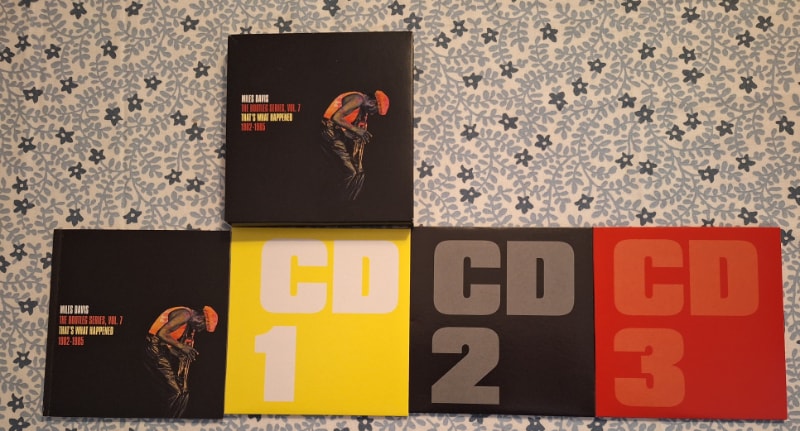
The packaging for the CD boxed set consists of three discs in coloured cardboard sleeves and a 50-page booklet, housed in a cardboard slip case.
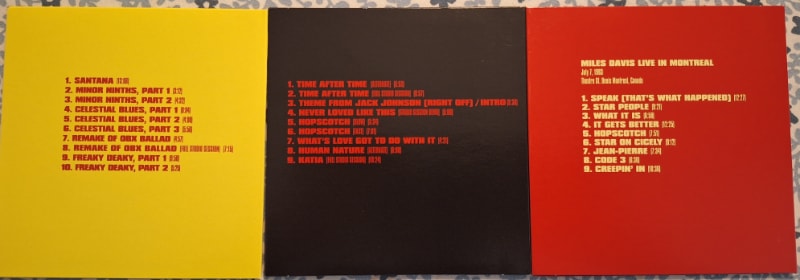
The back of each CD sleeve gives track and time information.
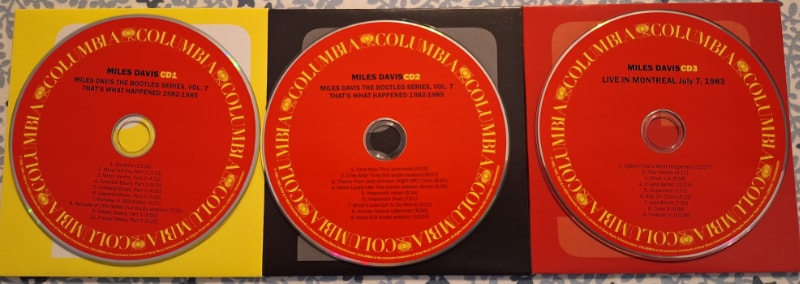
The CD labels have the old Columbia Records label.
CD Version
Disc 1 (Star People/*Decoy sessions)
- Santana
- Minor Ninths, Part 1
- Minor Ninths, Part 2
- Celestial Blues, Part 1
- Celestial Blues, Part 2
- Celestial Blues, Part 3
- Remake of OBX Ballad
- Remake of OBX Ballad full studio session)
- *Freaky Deaky, Part 1
- *Freaky Deaky, Part 2
“Santana” is a driving jazz-rock-funk number lasting 13 minutes, and elements of it can be found in other Miles’s tunes from this era, notably, “Hopscotch,” “Star On Cicely,” “Star People,” and ”Come Get It.” “Minor Ninths” is a duet featuring Miles on electric piano and J.J. Johnson playing trombone. Johnson also appears on Part 3 of “Celestial Blues.” “Remake of OBX Ballad” has Miles playing synthesiser, with Bill Evans on soprano sax and Marcus Miller on bass, playing the theme.
The version of “Freaky Deaky” is different from that on the album Decoy, with Miles playing trumpet and synthesiser, and John Scofield’s guitar bathed in wah-wah. By the way, all the tracks on this disc were probably recorded as one continuous take. Each take has been divided into two or three parts for this release.
It’s a shame that there is so little material from the Decoy sessions, because noted Miles Davis biographer Jan Lohmann visited Columbia Records archives to examine the tape boxes and session documentation. He found various sessions recorded around this period. These include a track called “Lift” recorded on 29 August 1983, with a line-up that included Branford Marsalis. During the same session, various takes of the title track “Decoy” were recorded, possibly including an early version that had Darryl Jones playing the bass with his fingers rather than thumping it with his thumb.
In June 1983, Miles recorded a tune called “The Funk” with saxophonist George Adams. For more on these sessions, visit Peter Losin’s excellent Miles Davis website, Miles Ahead.
One suspects that none of this music was included was because the original master tapes are either lost or mislaid. The Adams sessions tapes are missing, and the only reason we have the alternate takes of “Freaky Deaky”; is because, after the original session, John Scofield asked the engineer to make him a copy of the recording. Years later, when Scofield mentioned the session to the boxed set producers, they informed him that they could not find the tapes for that date. That’s why Scofield’s personal cassette copy is mentioned in the boxed set’s credits.
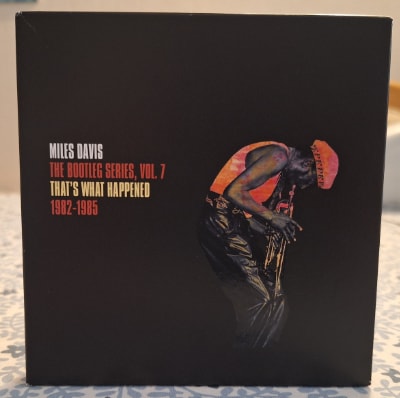
The front of the boxed set slipcase.
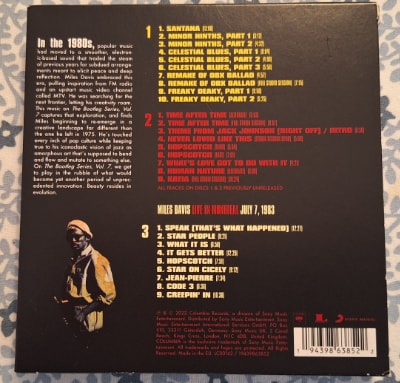
The back of the boxed set slipcase has a few lines of liner notes, plus track and time information.
Disc 2 (You’re Under Arrest sessions)
- Time After Time (alternate version)
- Time After Time (full studio session)
- Theme From Jack Johnson (Right Off) / Intro
- Never Loved Like This (studio session demo)
- Hopscotch (slow)
- Hopscotch (fast)
- What’s Love Got To Do With It
- Human Nature (alternate)
- Katia (full studio session)
Disc Two is devoted to the You’re Under Arrest sessions. The original plan was for Miles to record an album of pop tunes, with Gil Evans arranging, but Evans wasn’t available. We know from both Miles and engineer Ron Lorman, that the original concept was changed when the album was almost completed. Miles felt the album was too ballad-based and so scrapped it all and started again. Were any copies of the original album tracks kept?
Many pop tunes were transcribed, and while not all were recorded, some made it onto the album: Michael Jackson’s “Human Nature,” Cyndi Lauper’s “Time After Time,” and D-Train’s “Something On Your Mind.” On this release, there is a six-minute alternate version of “Human Nature,” which is similar to the album version.
The two takes of “Time After Time” include an alternate version, with a different drum track from Al Foster, and a full session version, featuring Vince Wilburn Jr on drums, which lasts eight minutes. The latter is not much different from the album version, except for the length of playing time.
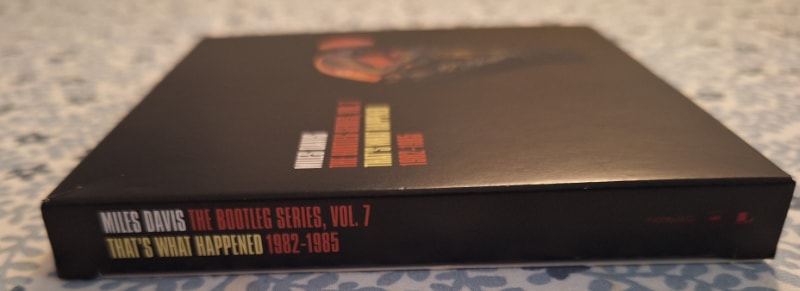
The slipcase spine.
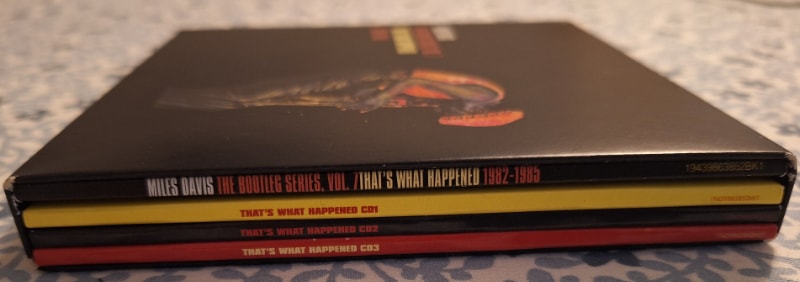
The three CDs and booklet fit snugly inside the slipcase.
“Never Loved Like This” composed by Miles and Robert Irving III, is a lovely studio session demo of a ballad that should have been developed. “Theme From Jack Johnson (Right Off) / Intro” is an eight-minute instrumental version of the opening number of the You’re Under Arrest album, but without various overdubs, including the opening dialogue featuring Miles, Police band member Sting and others.
“Hopscotch” is a jazz-funk tune which Miles played in many concerts. There are two versions (slow and fast) presented but neither can match the energy of the song when played live. The only unreleased pop ballad is the Tina Turner hit “What’s Love Got To Do With It,” which Miles also played live for a short while. The closing number is a jam session, “Katia,” featuring the fiery guitar playing of John McLaughlin. The album version lasted around seven minutes, but this version lasts for more than ten minutes. There’s more of Miles’s horn playing (both open and muted trumpet), more guitar soloing, and some overdubs are missing. It’s a raw, energetic and exciting end to the studio cuts.
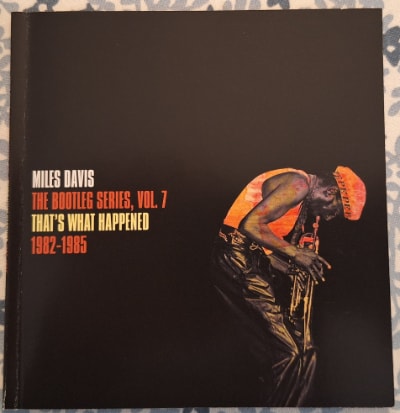
The cover of the CD booklet.
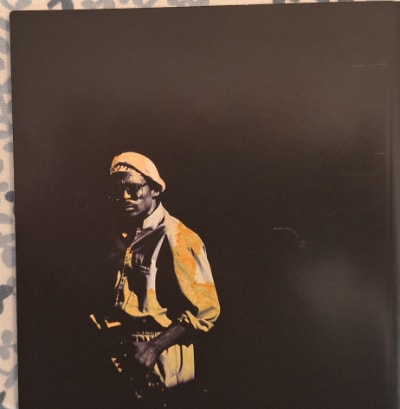
The back of the CD booklet.
Disc 3 (Live in Montreal 7 July 1983)
- Speak (That’s What Happened)
- Star People
- What It Is
- It Gets Better
- Hopscotch
- Star On Cicely
- Jean-Pierre
- Code 3
- Creepin’ In
Edited versions of “Speak (That’s What Happened)” and “What It Is” are on the Decoy album.
This disc contains the full concert that the band played at the International Jazz Festival in Montreal in July 1983. The venue was the Théâtre St. Denis.
A week before, the band had been a septet, with a two-guitar line-up featuring Mike Stern and John Scofield. Stern left, leaving Scofield with more space, more scope and more soloing opportunities. The band was right on form on the night.
The opening number “Speak (That’s What Happened)” is a ferocious jazz-funk workout, with Foster and Jones laying down a heavy backbeat and Evans playing some furious licks during his tenor sax solo. The complete track runs for eleven and a half minutes, and Miles placed an edited version on the Decoy album (the edit point is at 9.18), leaving the final four minutes or so to become a new number called “That’s What happened.” “What It Is” was edited and given new intro on Decoy, but here is the full fat six-minute version. Jones plays with such power and ferocity and his playing has a harder edge than previous bass players in Miles’s bands.
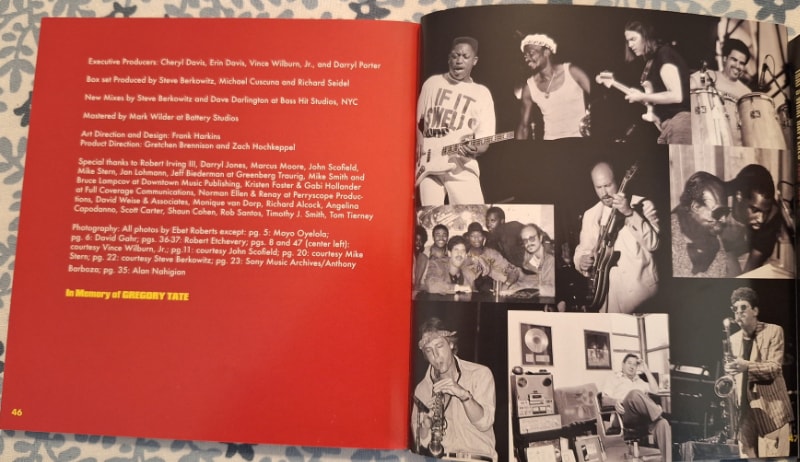
The CD booklet has lots of photos of Miles and band members from the 1980s. If you look carefully, you’ll also see a photo of Miles’s producer Teo Macero sitting in his office at Columbia Records.
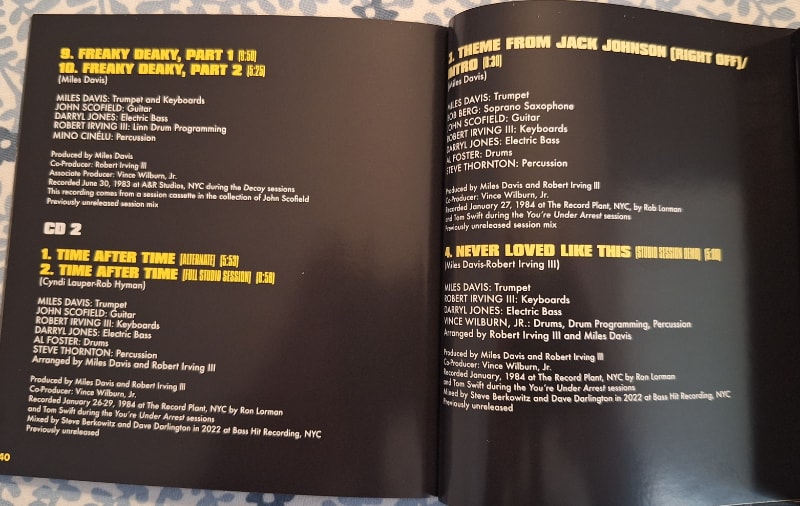
Personnel information, along with studio location and recording date, is given for each track.
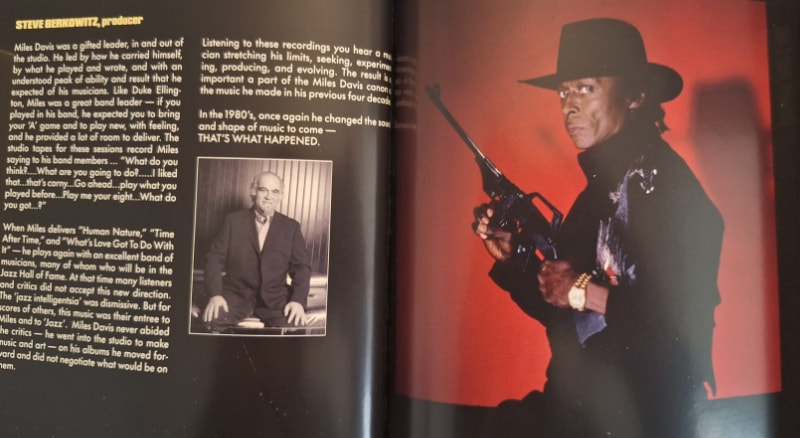
Steve Berkowitz, one of the boxed set producers, provides some liner notes.
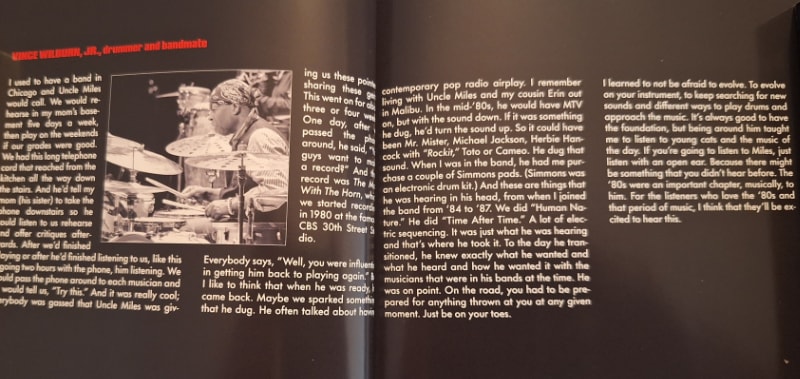
There are recollections of playing with Miles from a handful of past members, including Miles’s drummer and nephew Vince Wilburn Jr.
Miles’s playing is much stronger than on previous albums, going from moving slow blues lines to explosive phrases that soar to the sky. Scofield also shines throughout the concert, most noticeably on the two blues numbers “Star People” and “It Gets Better.” His blues-drenched solos on “Star People” and “It Gets Better” are especially impressive. Evan plays a long, expressive solo on “It Gets Better.”
Miles completists will find the addition of the two final tracks “Code 3” and “Creepin’ In” (both lasting around nine minutes long) of interest, because as far as is known, this is the only time they were ever played in concert. Both tunes are abstract, with hints of other song themes (such as ‘Hopscotch’) dotted here and there. All in all, this is a fine concert, but it’s a shame that a full concert featuring the Scofield/Stern line-up has so far, not been released.
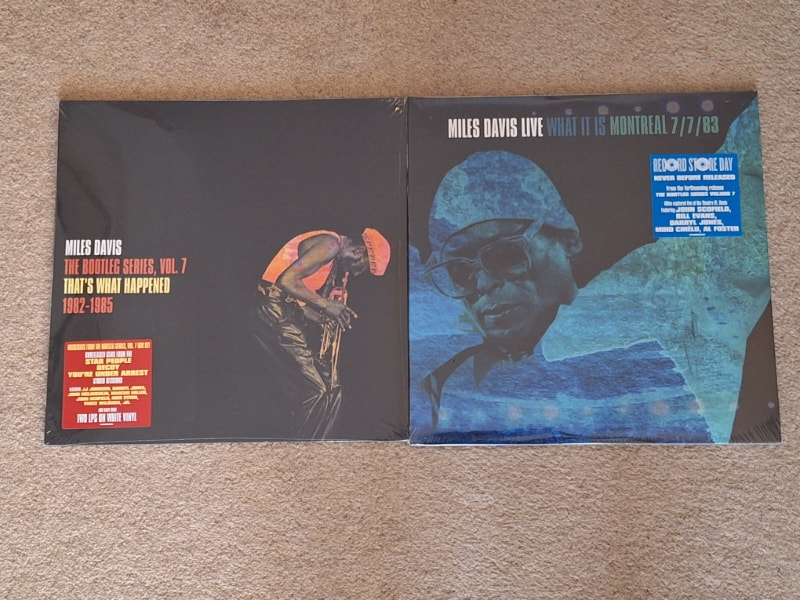
Front covers of the two LP album releases.
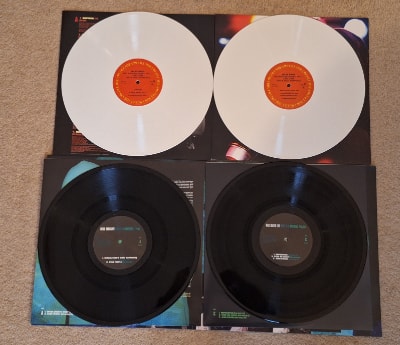
The LPs have different coloured vinyl.
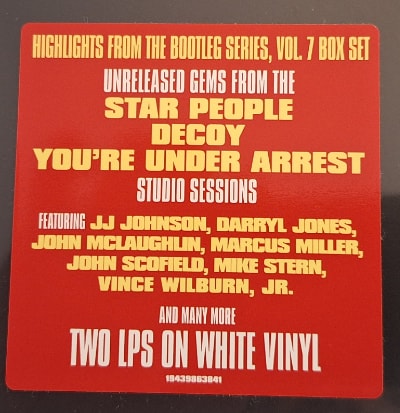
Sticker from the studio recordings LP.
Miles Davis: The Bootleg Series 7, That’s What Happened, 1982-1985 – LP Version
LP 1
Side A
- Santana
- Minor Ninths Part 2
- Celestial Blues Part 2
Side B
- Remake of OBX Ballad
- Time After Time (Alternate)
- What’s Love Got To Do With It
- Human Nature (Alternate)
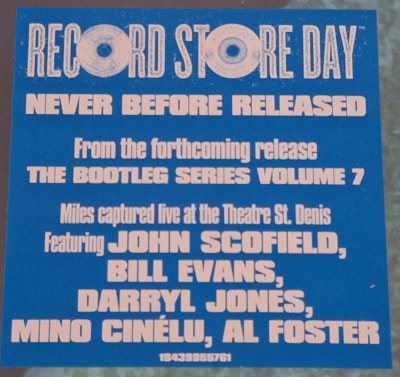
Sticker from the Montreal concert LP.
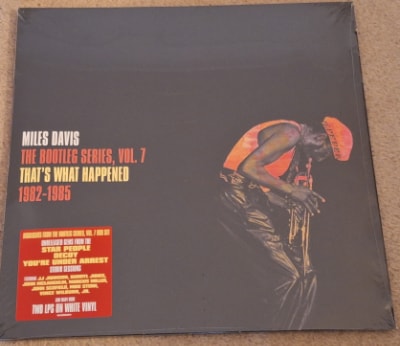
The front cover of the studio recordings LP. It is a single sleeve.
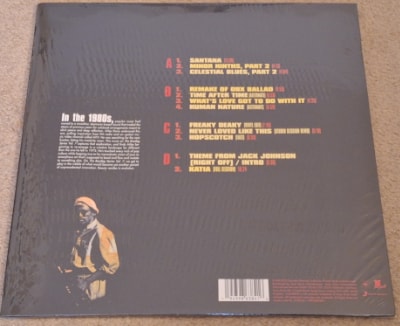
The back cover of the studio recordings LP includes track and time information.
LP 2
Side A
- Freaky Deaky (Vinyl Edit)
- Never Loved Like This
- Hopscotch (Fast)
Side B
- Theme From Jack Johnson/Right Off//Intro
- Katia (Full Session)
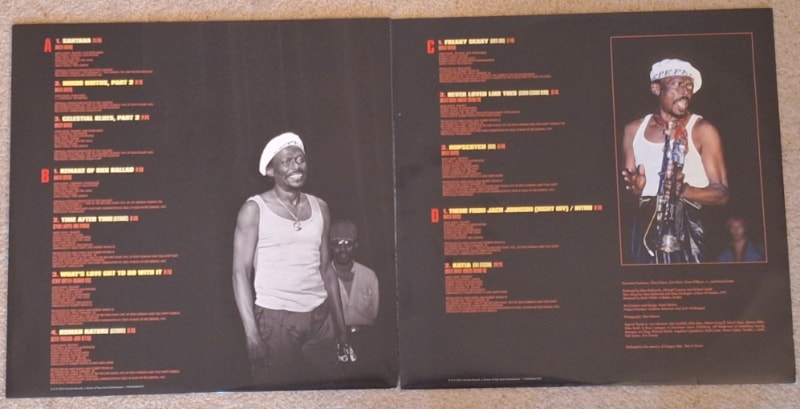
The LP dust jackets include the notes of Marcus J. Moore, photos and track and personnel information.
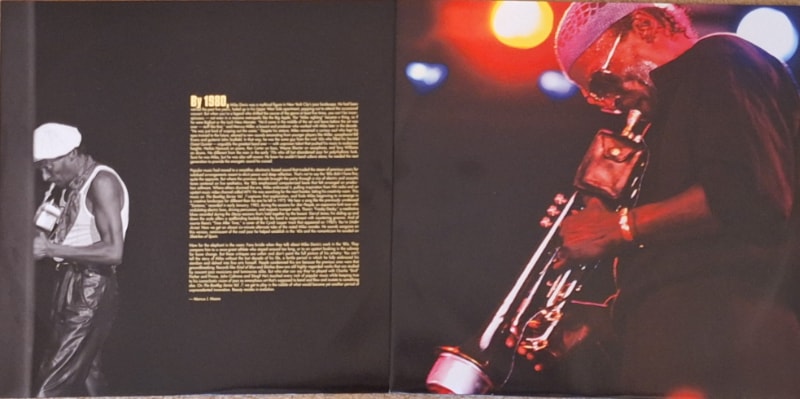
The LP dust jackets include the notes of Marcus J. Moore, photos and track and personnel information.
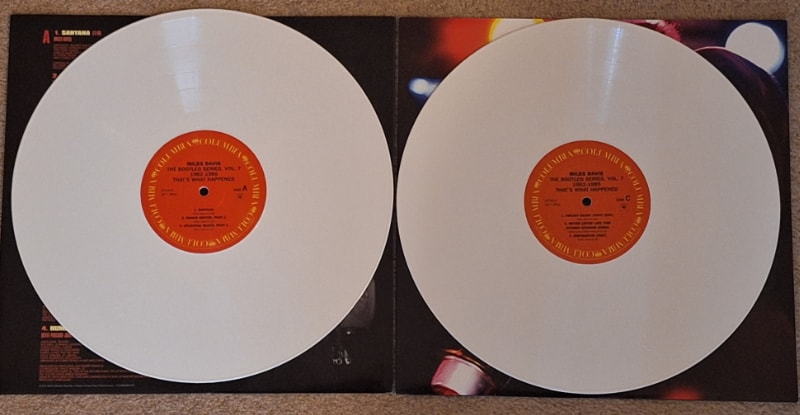
The studio recordings album has two LPs with white vinyl.
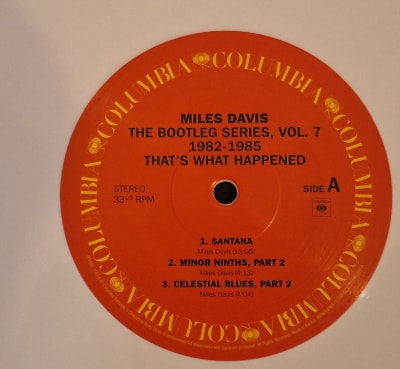
The studio album has the old Columbia Records label.
The album comes in two discs, both in white vinyl. A single LP sleeve houses both discs. Even with four sides of vinyl, it’s not possible to fit all of the two-hour’s worth of studio tracks onto two LPs. Hence, we have the highlights. Missing from the CD release are: “Minor Ninths” Part 1, “Celestial Blues” Parts 1 & 3, “Remake of OBX Ballad” full studio session, “Time After Time” full studio version, and “Hopscotch” (slow). “Freaky Deaky” Part 1 is also trimmed by a couple of minutes. Overall, it’s a good editing job, although most of the content of the CD booklet is absent, save Marcus J. Moore’s liner notes.
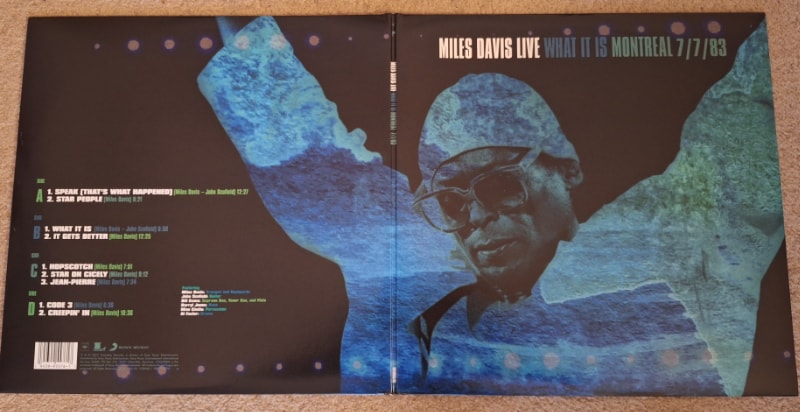
The Montreal concert album comes in a gatefold sleeve. These are the front and back covers,
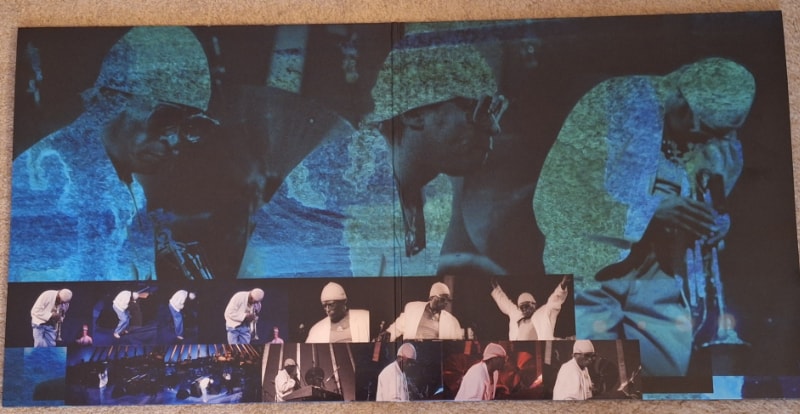
The inside of the gatefold sleeve has various photographs of Miles in concert.
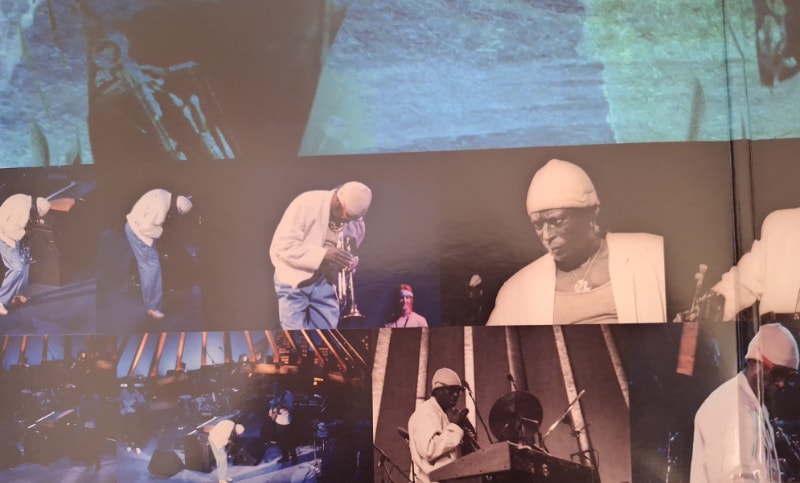
A close-up of some of the photographs.
Miles Davis Live, What It Is, Montreal 7/7/83 – LP Version
LP 1
Side A
- Speak (That’s What Happened)
- Star People
Side B
- What It Is
- It Gets Better
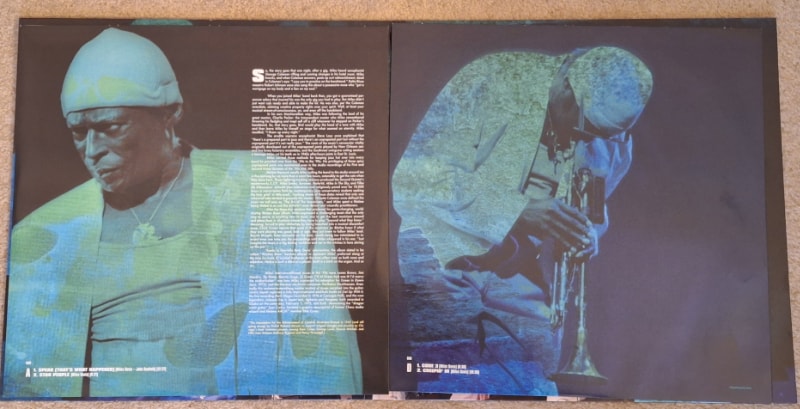
The LP jackets include liner notes from Gregory Tate, personnel and production information, plus photographs of Miles.
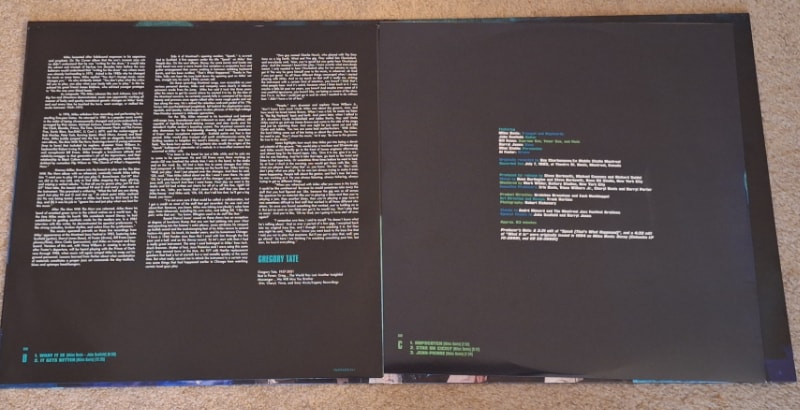
The LP jackets include liner notes from Gregory Tate, personnel and production information, plus photographs of Miles.
LP 2
Side A
- Hopscotch
- Star On Cicely
- Jean-Pierre
Side B
- Code 3
- Creepin’ In
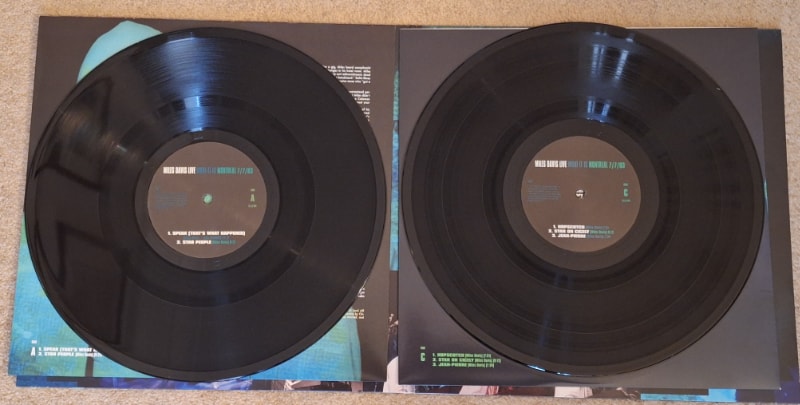
The concert LPs are pressed on black vinyl.
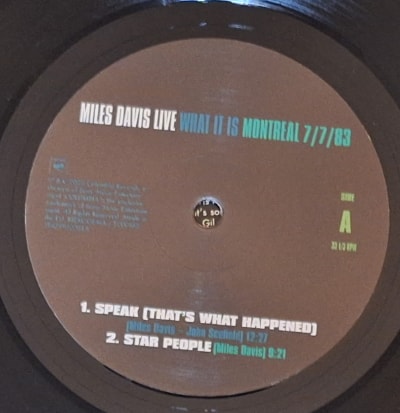
A close-up of the album label. The old Columbia Records label, used by the CD boxed discs, and the studio recordings LPs, is replaced with a modern design.
This album comes in two discs, housed in a gatefold sleeve, the inside featuring photos not found in the CD booklet. The complete concert is spread over four LP sides and presented in the same order as on the CD. The only text content from the CD booklet consists of Gregory Tate’s liner notes, and there are some concert photos not featured in the CD booklet. The albums are pressed on black vinyl, and both have a modern label design.
The Bootleg Series 7, That’s What Happened is available on CD, vinyl, and download from Amazon UK and Amazon US.
 The Man With The Horn |
 We Want Miles |
 Star People |
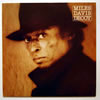 Decoy |
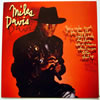 You're Under Arrest |
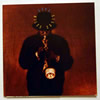 Aura |
 Rubberband |
 Tutu |
 Siesta |
 Amandla |
 Dingo |
 The Hot Spot |
 Doo-Bop |
 Live Around The World |
 Montreux 1973 - 1991 |
 miles alive |
 Miles Davis Trilogy |
 Time After Time |
 Perfect Way |
 Hollywood Bowl 1981 |
 Original Classics |
 Complete Columbia Collection |
 Tutu Deluxe Edition |
 Montreal Concert |
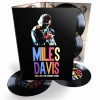 1986 - 1991 Warner Years |
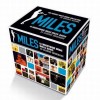 Perfect Miles Collection |
 On The Crest Of The Airwaves |
 The Last World |
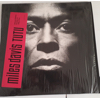 Tutu Deluxe LP |
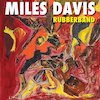 Rubberband |
 Music from Birth of the Cool |
 Original Album Series |
 Merci Miles! Live at Vienne |
- Miles 80s Music Collections - a round up of various Miles compilations from the 1980s
- The Man With The Horn Album Primer - An Introduction To Miles’ 80s album
- We Want Miles Album Primer - An Introduction To Miles’ live album from 1982
- Star People Album Primer - An Introduction To Miles’ album from 1983
- Decoy Album Primer - An Introduction To Miles’ album from 1984
- You’re Under Arrest Album Primer - An Introduction To Miles’ album from 1985
- Tutu Album Primer - An Introduction To Miles’ album from 1986
- Aura Album Primer - An Introduction To Miles’ album from 1989
- Miles Live - a round up of the various Miles live albums from the 1980s