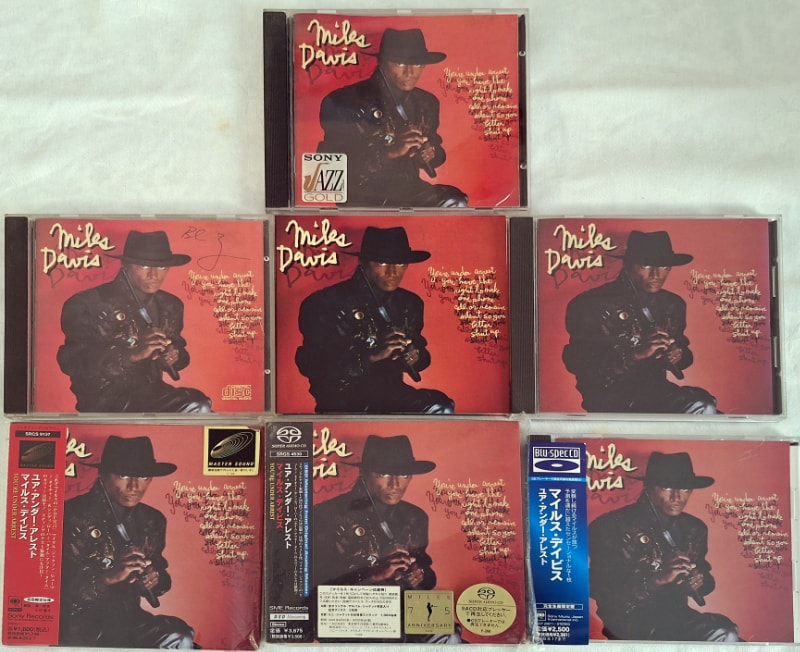
The album has appeared in various CD formats: standard, Master Sound, SACD, and Blu-Spec.
Background: Jazz musicians have traditionally played the popular tunes of the day and Miles Davis was no exception. In the past, he had recorded songs such as ‘My Funny Valentine,’ ‘If I Were A Bell,’ and ‘Summertime.’ In late 1983, Miles decided that his next recording would be an album of the pop songs of the day, with his old friend and musical associate Gil Evans handling the arrangements.
But Evans was a slow and meticulous worker and also had other engagements. Miles was a man in hurry, juggling recording sessions with touring dates, so he decided to press ahead without Evans’ involvement. Miles’s musical director Robert Irving III and his guitarist John Scofield were tasked with transcribing dozens of pop tunes. Some of these were later recorded, but how many have Miles playing on them is not known.
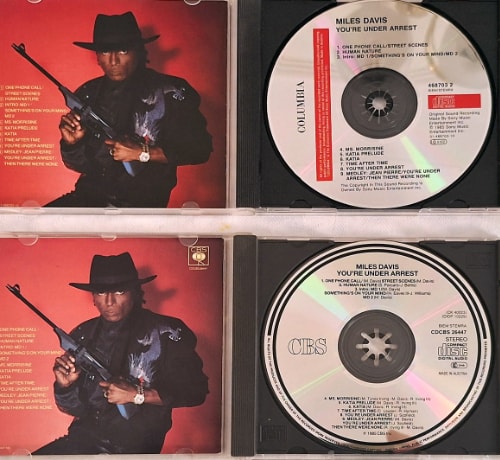
The standard version has two different silver labels.
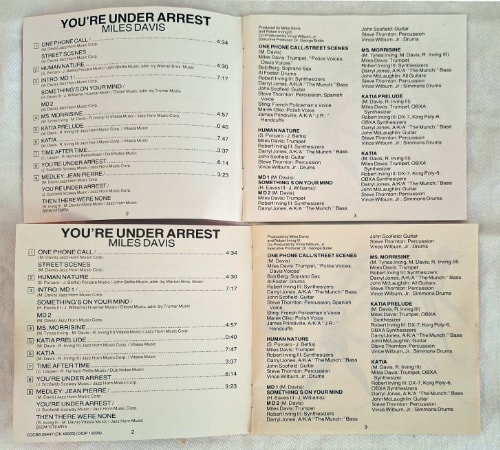
Booklets for the standard CD contain track and personnel information.
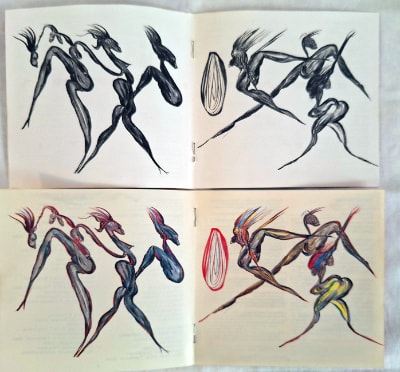
The inside booklet of the standard CDs contain the same Miles artwork in either colour or black and white.
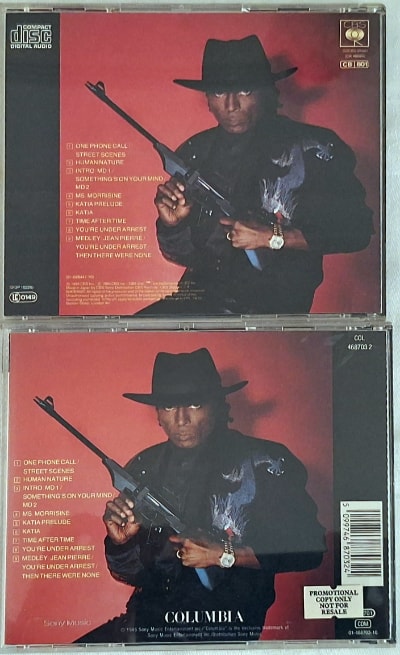
The back cover of the standard CD varies slightly.
By the time You’re Under Arrest came to be recorded, Miles had two new band members: Bob Berg on tenor and soprano sax, and Steve Thornton on percussion. You’re Under Arrest features a couple of notable guest musicians: the singer and bassist Sting from the pop band The Police, and guitarist John McLaughlin, who played on many of Miles’s classic jazz-rock fusion albums, including Jack Johnson, In A Silent Way and Bitches Brew.
After recording around a dozen pop tunes, the record was about to be mixed, when Miles instructed his recording engineer Ron Lorman, to wipe most of the recordings and strip them back to their drum tracks. Miles felt that the album needed more uptempo tunes, and so, in a frenzy of recording over late December 1984 and early January 1985, a slew of new tunes were recorded.
The new version of the album included several pop tunes, as well as uptempo jazz-funk songs, and a couple of songs that addressed social issues. You’re Under Arrest merges jazz with pop and funk, and as result, some songs got a lot of radio airplay, and the album soon sold more than 100,000 copies. It was the last album Miles recorded on American soil for Columbia Records.
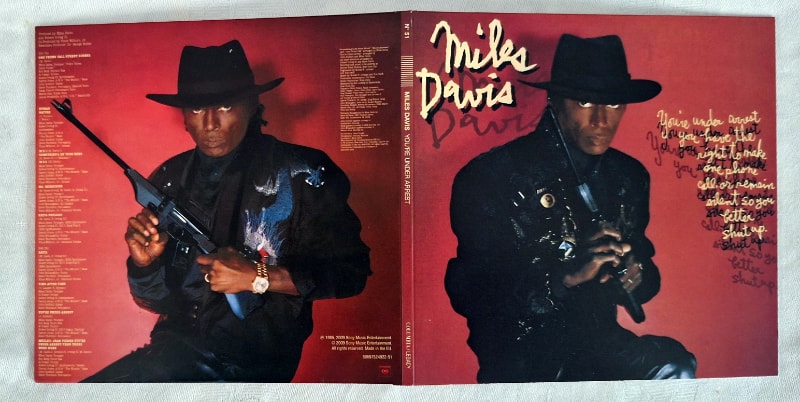
The Complete Columbia Album Collection (CCAC) boxed set has a miniature cardboard version of the LP cover.
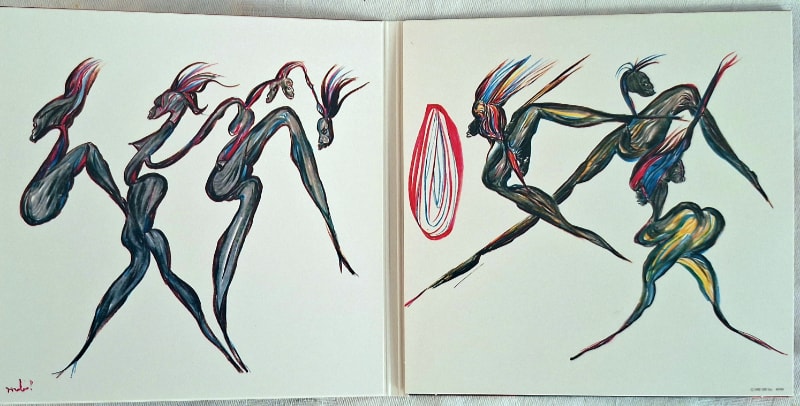
The inside cover of the CCAC version.
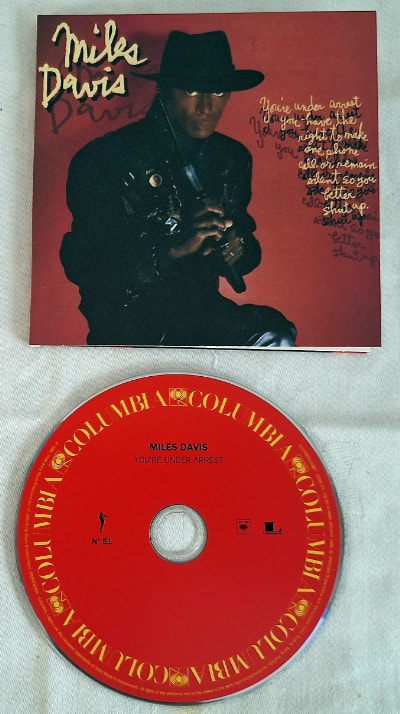
The cover and label for the CCAC version.
Tunes:
- One Phone Call/Street Scenes
- Human Nature
- MD1/Something’s On Your Mind/MD2
- Ms Morrisine
- Katia (Prelude)
- Katia
- Time After Time
- You’re Under Arrest
- Medley: Jean-Pierre/You’re Under Arrest/And Then There Were None
Producers: Miles Davis and Robert Irving III.
Co-producer: Vince Wilburn Jr.
Executive Producer: George Butler.
Recorded: August 1984-January 1985.
Released: 1985.
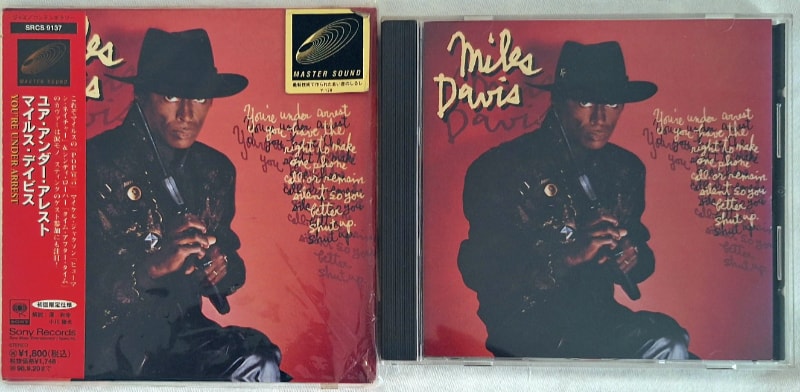
Sony Music Japan released Master Sound versions of the album. The original 1996 release had a miniature cardboard album cover, but the 2000 Master Sound release came in a CD Jewel case.
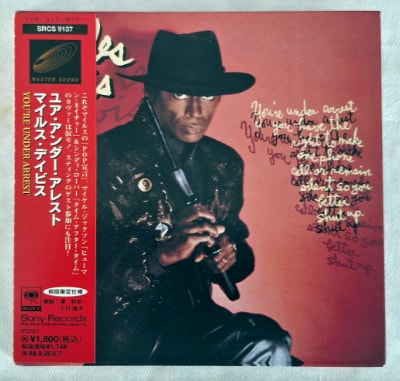
The 1996 Master Sound release had a cardboard cover and red OBI strip.
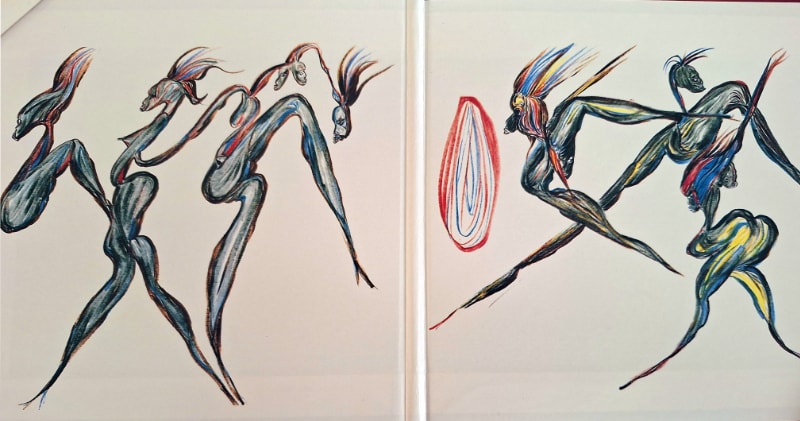
Inside album cover of 1996 Master Sound release.
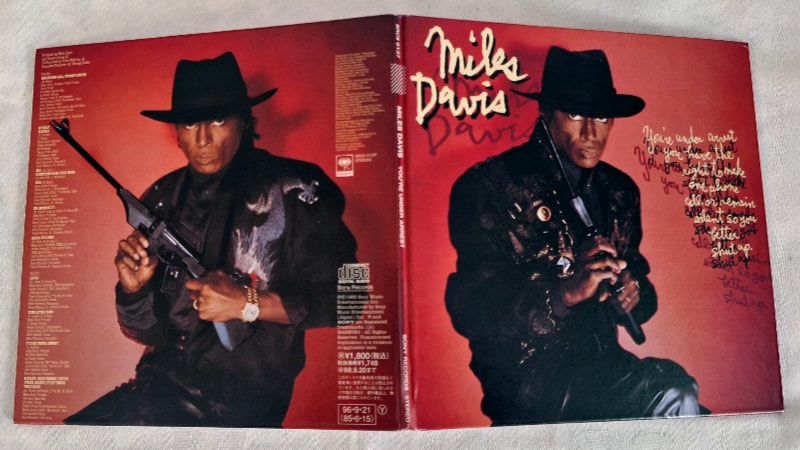
Front and back covers of 1996 Master Sound.
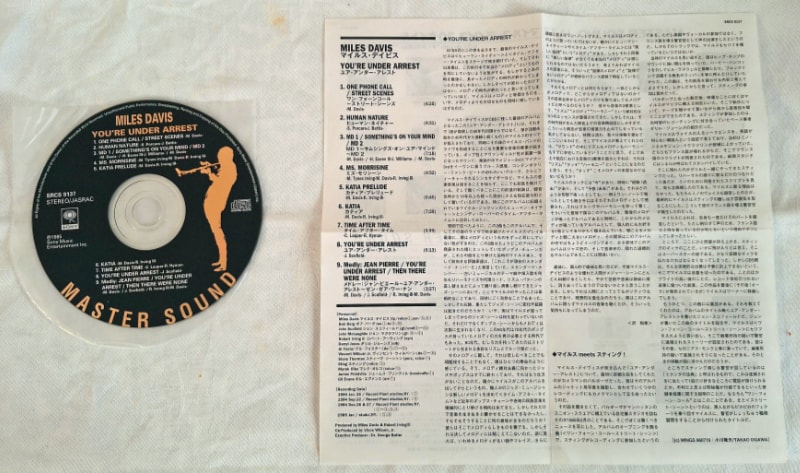
Black label and liner notes for 1996 Master Sound.
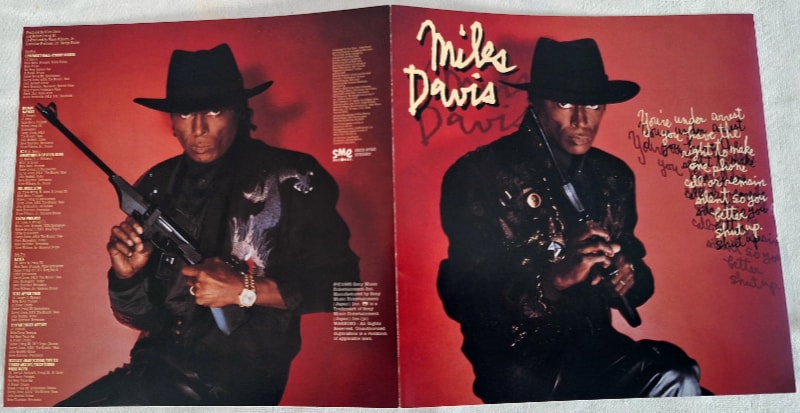
The 2000 Master Sound paper cover.
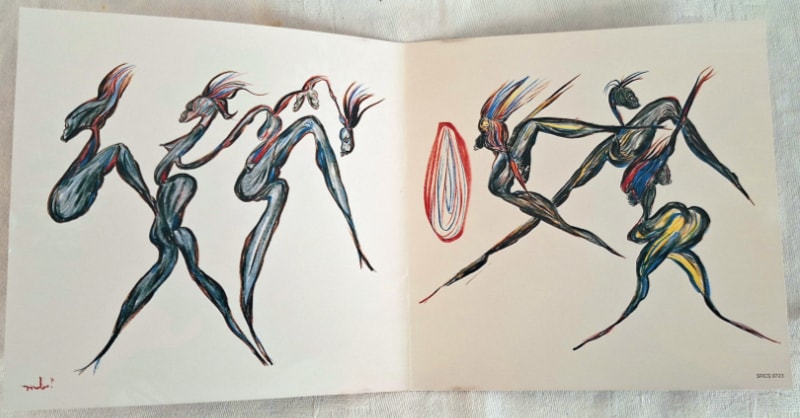
Inside artwork for the 2000 Master Sound release.
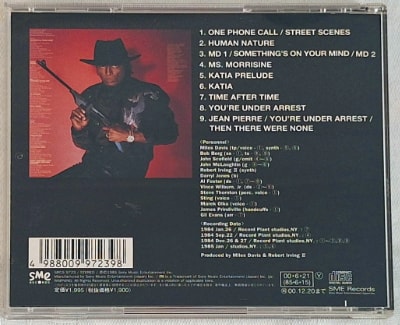
Back cover of the Master Sound release.
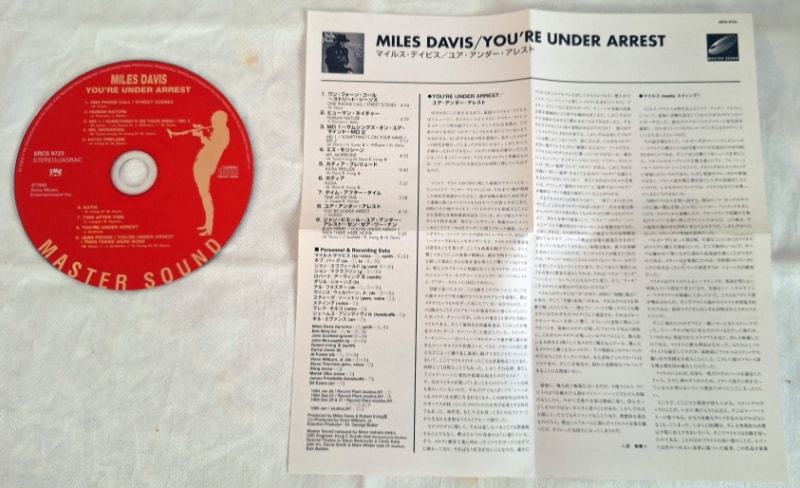
Red label and liner notes for 2000 Master Sound version.
Musicians:
- Miles plays trumpet, synthesiser.
- Keyboards: Robert Irving III.
- Sax; Bob Berg.
- Guitar: John Scofield, John McLaughlin (tracks 4, 5, 6).
- Bass: Darryl Jones.
- Drums: Al Foster (tracks 1, 7, 8, 9), Vince Wilburn Jr (tracks 2, 3, 4, 5, 6).
- Percussion: Steve Thornton.
- Voice: Miles (track 1 and 9); Sting (track 1), Marek Olko (track 1), Steve Thornton (track 1).
- Handcuffs: James Prindiville (track 1).
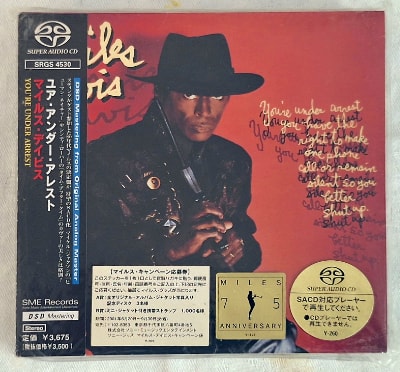
The Super Audio CD (SACD) came in a large, thick cardboard cover.
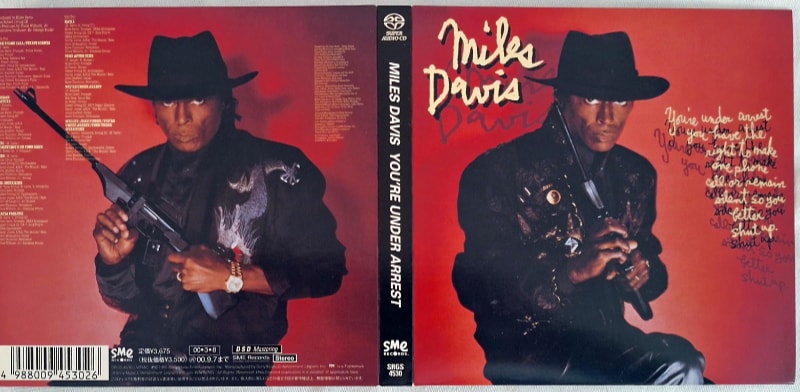
Front and back covers of SACD version.
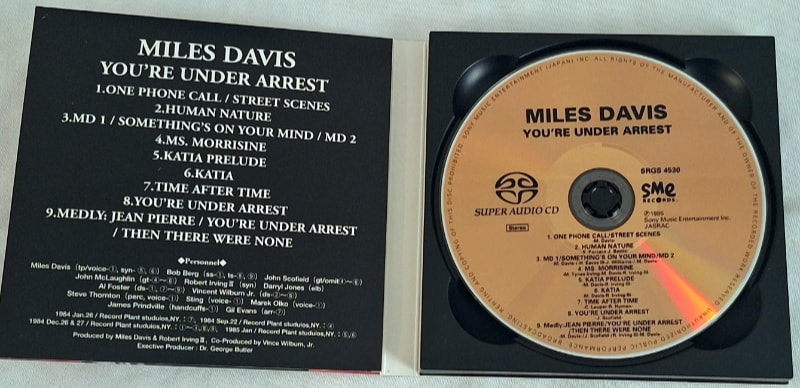
There was no artwork, just credit information and a gold CD.
A dozen facts about You’re Under Arrest:
- Miles said the album’s full title was You’re Under Arrest, You Have The Right To Make One Phone Call Or Remain Silent, So You Better Shut Up. These words appear on all versions of the album cover.
- Miles was considering recording pop tunes performed by many artists, including, Cyndi Lauper, Michael Jackson, D-Train, Tina Turner, Debarge, Nik Kershaw, Dionne Warwick, Kenny Loggins, Chaka Khan and Roberta Flack. Only songs from the first four artists have been the released: the first three are on the You’re Under Arrest album, and the fourth on the boxed set release That’s What Happened.
- The album is book-ended by tracks that address social issues. The first, ‘One Phone Call/Street Scenes’ is about police racism in the United States, while the last, a medley of three songs, including the closing tune ‘And Then There Were None,’ is about nuclear war. Both tracks feature Miles’s voice.
- Cyndi Lauper’s ‘Time After Time’ became a concert favourite. Miles had played it live many times before recording it. According to the excellent Miles website, miles-davis.de, Miles played it 300 times in concert, from January 1984 until his last live performance, at the Hollywood Bowl on 25 August 1991.
- The title track was written by John Scofield and originally known as ‘The Back Room.’ It was Miles’s idea to change the title. It is reprised in the medley in the following track.
- Music from three earlier Miles tunes appears on the album. ‘Street Scenes’ uses the riff from ‘Right Off’ on the Jack Johnson album; ‘One Phone Call’ is based on the second theme of ‘Speak’ from the album Star People, while ‘Jean-Pierre’ first appeared on the We Want Miles live album.
- Sting appears as a French policeman on the opening number ‘One Phone Call/Street Scenes.’ He had just finished auditioning Darryl Jones for a new band he was forming (Jones got the gig), and on learning that Jones was going onto a Miles studio session, tagged along. In the studio, Miles asked Sting if he spoke French and then got him to read out the American Miranda Rights, which are read to a suspect by an arresting police officer. According to the Japanese liner notes for the Master Sound version of You’re Under Arrest, Miles told interviewer Kazuyuki Sawa, that John McLaughlin and Miles’s previous percussionist Mino Cinelu, were also considered for the police officer’s part (Cinelu even recorded his part). Miles also said that he had had to pay Sting for his contribution out of his own pocket, which annoyed him.
- Also on ‘One Phone Call/Street Scenes was Miles’s road manager, Jim Rose. He provided the handcuffs that were used for sound effects. In an interview for this website Jim Rose explained the story: “I had a pair of handcuffs with my briefcase [which was usually full of cash] and Miles knew I had them, because when we would go to some place, I would handcuff my briefcase to some plumbing or something. He asked me to make the sound with the handcuffs because you could push the handcuff and get this clicking sound. I said, “I’m not in the Musician’s Union so just put [the album credit] as [James] Prindiville on handcuffs and nobody will have a clue as to who that is, which is my middle name.”
- Miles’s nephew, Vince Wilburn Jr took over the drummer’s chair after long-time friend and musical associate Al Foster walked out of sessions for ‘Human Nature,’ citing musical differences.
- You’re Under Arrest was the second album to feature Miles’s artwork. The CD booklet has an abstract image on the inside cover, either in colour or black and white. The LP inner sleeve was covered with a large sketch containing numerous characters. This image was never used for any other audio format.
- The album cover has a striking cover of Miles holding a gun. The concept was devised by Miles and photographer Anthony Barboza, a long-time friend of Miles. Barboza used to take photographs of Miles’s girlfriends, and also directed Miles in two adverts. Miles was right-handed but Barboza felt it looked better artistically if he held it as if he was left handed. Miles biographer Ian Carr memorably described the cover as one which “boldly combines camp with kitsch. Against a red background, a colour reminiscent of the décor of a Toulouse Lautrec brothel, Miles – wearing a black homburg and the black garb of a Spanish dancer – holds an automatic gun in both hands.”
- John McLaughlin appears on three numbers: ‘Ms Morrisine,’ Katia Prelude’ and ‘Katia’. McLaughlin was in New York and called Miles to say hello. Miles asked him to come to the studio and play. The guitarist appeared with his then partner, the classical pianist Katia Labèque. ‘Ms Morrisine’ was written by Robert Irving III and his then wife, Morrisine. A motif from this song was used to create a new tune, ‘which was effectively a long studio jam. Miles later called it ‘Katia’ and Labèque later recorded her own version of the tune. An unedited version of ‘Katia’ appears on the That’s What Happened boxed set.
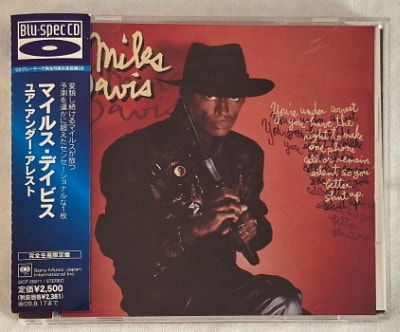
Blu-Spec CD cover.
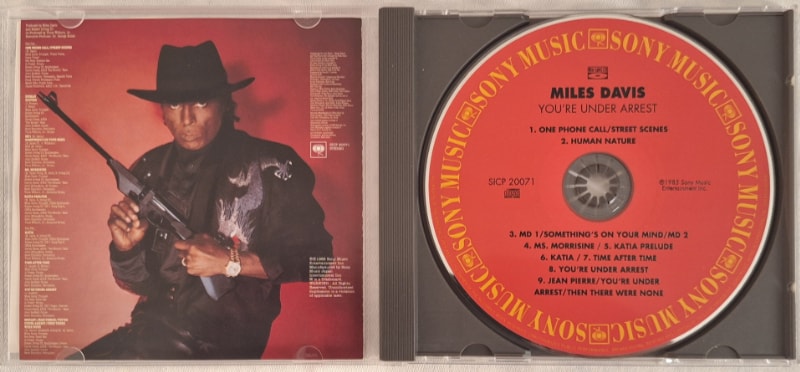
Blu-spec label and back CD booklet cover.
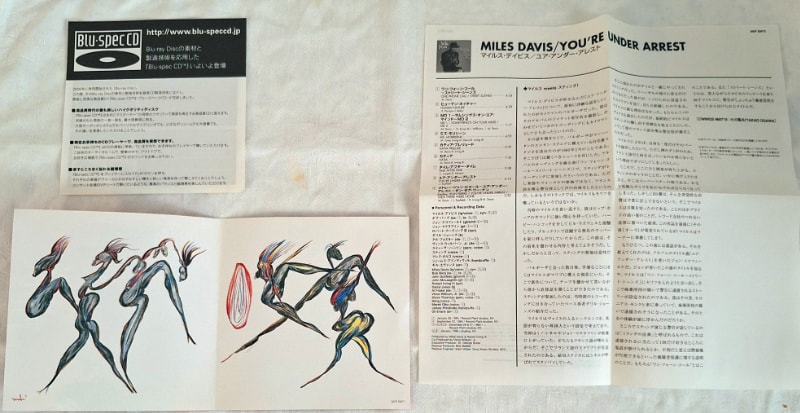
Liner notes, artwork and information about the Blu-Spec format.