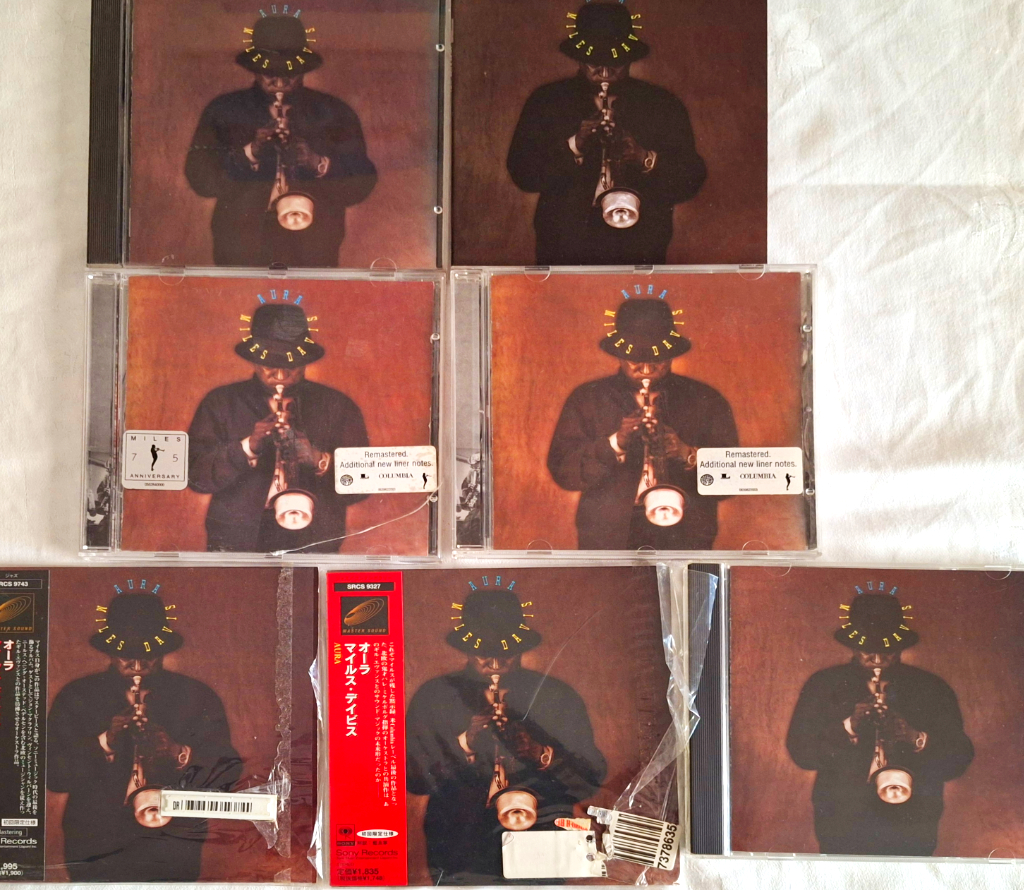
Aura has been released in several CD formats, standard CD (top); remastered (middle) and several Master Sound versions (bottom)
Background: In 1984, Miles became the first black artist and jazz musician to win the prestigious the Sonning Music Award, Denmark’s highest musical honour. The Sonning Awards Committee hoped that Miles’s long-time musical associate Gil Evans would write some music for the award ceremony, but Evans was unable to complete the music in the time required.
Two other composers were then asked to write the music, one of whom was Danish trumpeter/composer/arranger Palle Mikkelborg. Mikkelborg composed a suite comprising of seven movements, which he called Aura. The inspiration behind the piece was Miles’s musical and personal aura. Miles chose Mikkelborg’s music to be played at the ceremony. The music was performed by the Danish Radio Big Band, plus several guest musicians invited by Mikkelborg.
“It was like an orchestral tribute or homage to his life in these seven colours,” says Mikkelborg. There were seven movements to Aura – ‘Yellow,’ ‘Orange,’ ‘Red,’ ‘Green,’ ‘Blue,’ ‘Indigo,’ and ‘Violet’ – and Miles was only supposed to play on the last movement at the awards ceremony. The ceremony took place in Copenhagen on 14 December and Miles brought along his guitarist John Scofield as second soloist on the piece ‘Violet’. But such was the crowd reaction that Miles remained onstage and played for over an hour. It was the first time Miles had played with a big band for more than twenty years.
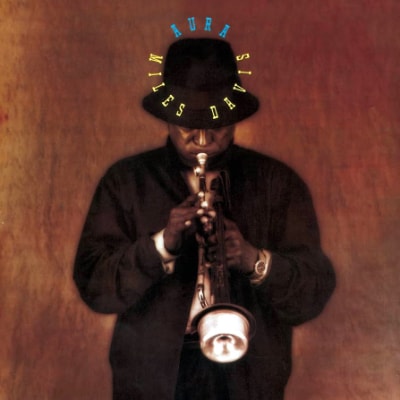
The standard CD cover shot.
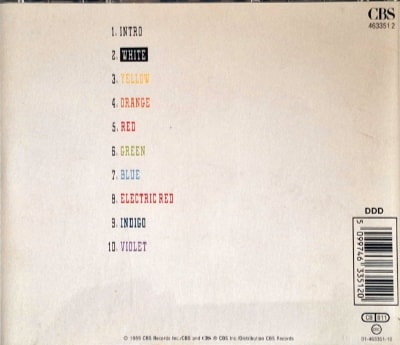
The back cover of the standard CD.
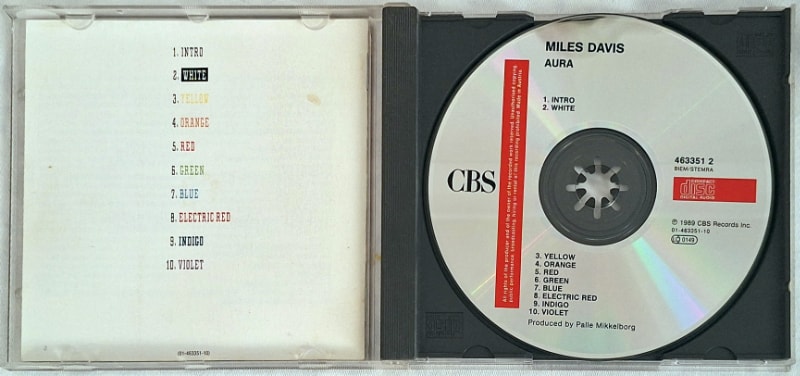
The standard CD silver label.
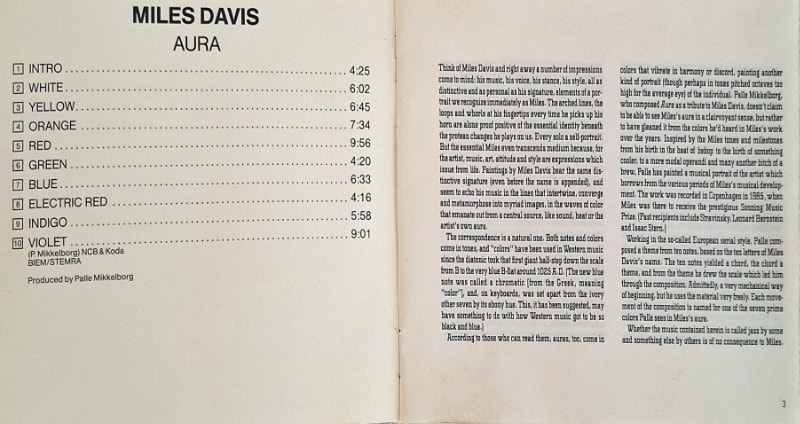
The CD booklet contains excellent liner notes by American writer Kephra Burns.
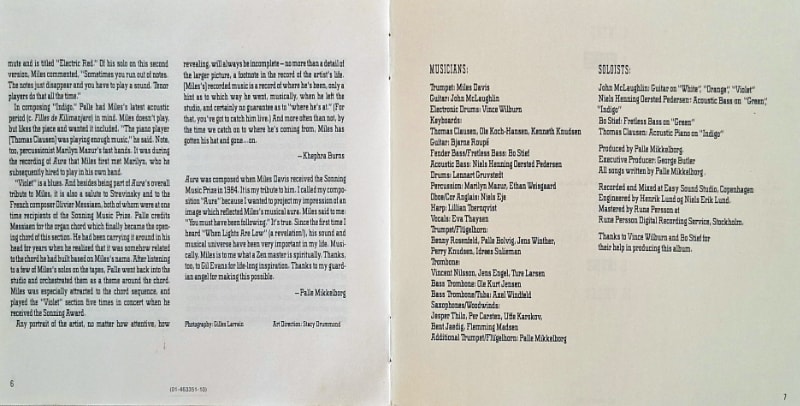
One disappointing aspect of the original Aura release was how little credit Palle Mikkelborg received on the album’s cover artwork. His short liner note was tagged at the end of the main liner notes.
Several weeks later, Mikkelborg was woken up in the middle of the night by a telephone call from Miles, who informed the Dane that he was planning to return to Denmark in a couple of weeks to record the music! Mikkelborg spent a frantic fortnight preparing the music, finding the musicians and booking studio time.
Miles arrived again in Copenhagen with his drummer Vince Wilburn Jr, who played electronic drums on some of the pieces. John McLaughlin happened to be in Copenhagen when Miles was recording Aura, and he was drafted in to play on three songs. Miles was very happy with the resulting music, describing it in his autobiography as a “masterpiece.” Alas, it would be four years before the album was released by Columbia Records. But when it was, many critics described it as being one of Miles’s finest albums for years.
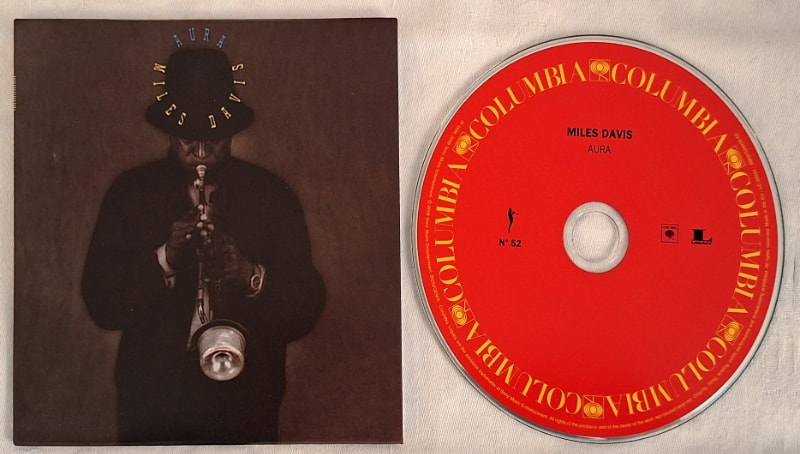
The Complete Columbia Album Collection (CCAC) boxed set offers Aura in a small cardboard sleeve with a red Columbia Records label on the CD.
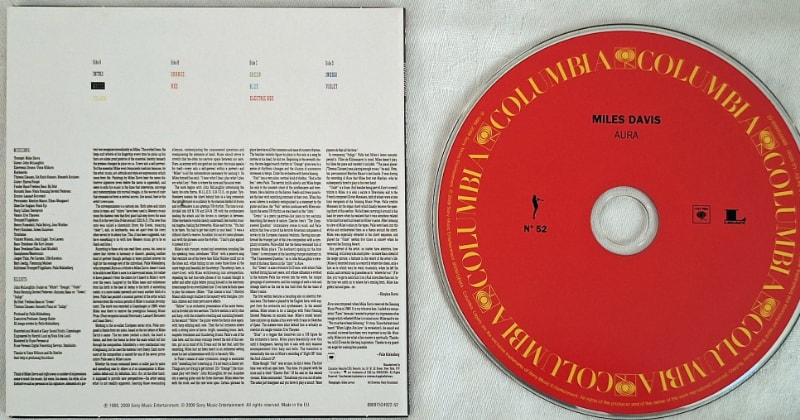
The back cover of the CCAC disc includes the album liner notes, but the typeface is extremely small!
Tunes:
- Intro
- White
- Yellow
- Orange
- Red
- Green
- Blue
- Electric Red
- Indigo
- Violet
Producer: Palle Mikkelborg.
Executive Producer: George Butler.
Recorded: 31 January-4 February 1985.
Released: 1989.
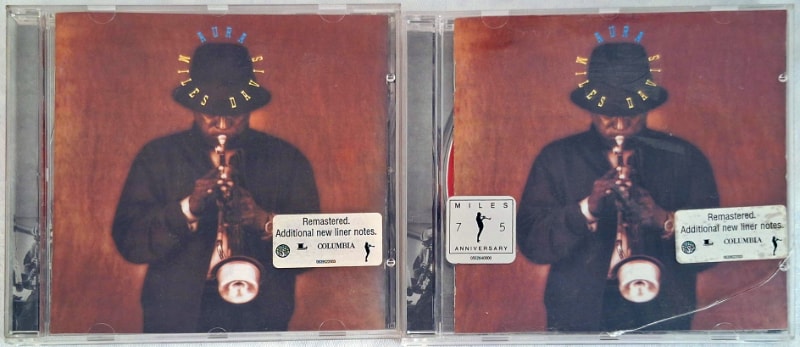
In 2000, Aura was remastered, and the album artwork and credits were improved. The disc on the right was released to celebrate the 75th anniversary of Miles’s birth in 2001.
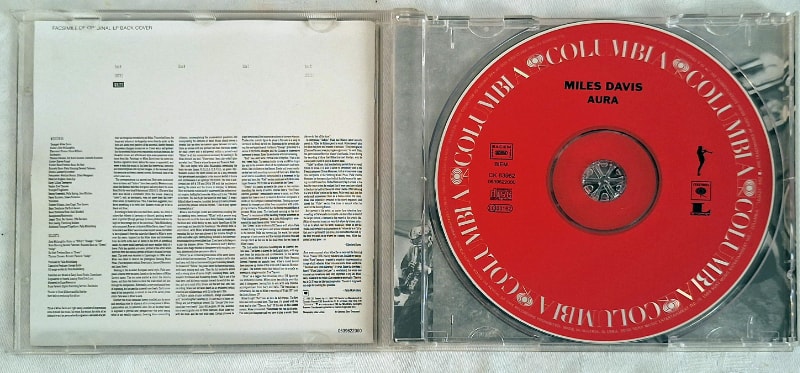
The remastered CD case opened.
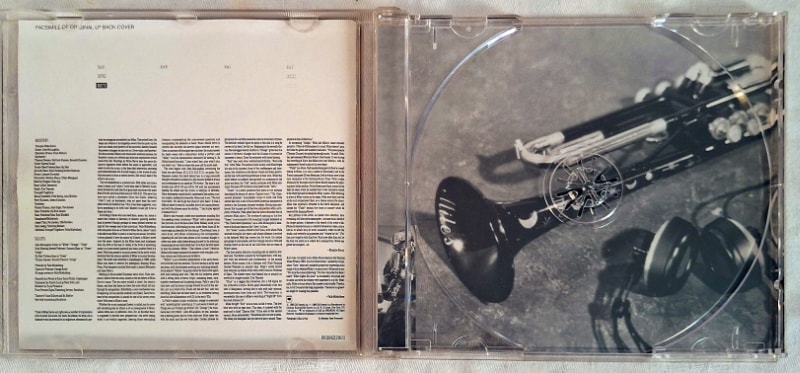
The disc inlay had a transparent plastic with a photo of Miles’s trumpet beneath.
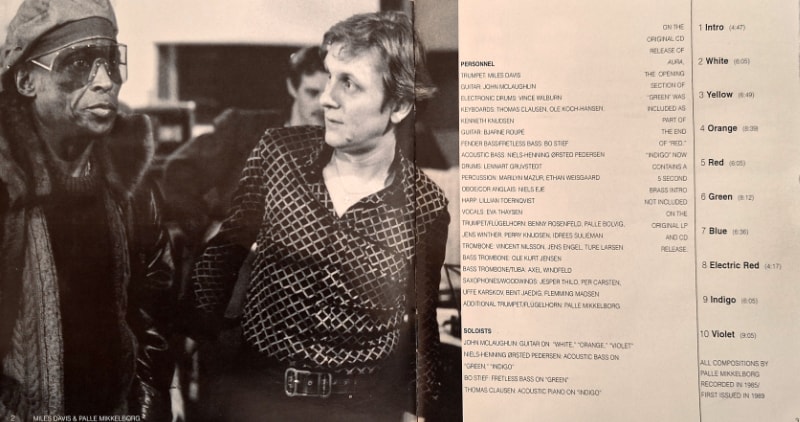
The CD booklet contained photographs including this one of Miles with Palle Mikkelborg.
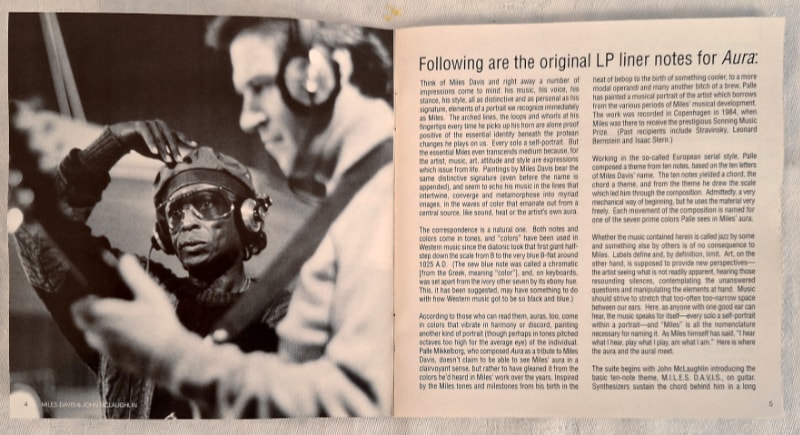
The original liner notes were included, but this time with photographs. This one shows Miles with John McLaughlin in the studio.
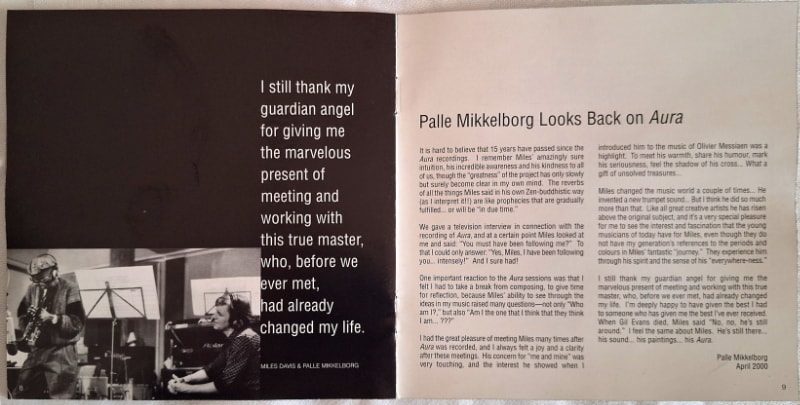
The remastered CD booklet contains additional liner notes from Palle Mikkelborg.
Musicians:
- Miles plays trumpet on all tracks except 9.
- Trumpet and flugelhorn: Benny Rosenfeld; Palle Bolvig; Jens Winther; Perry Knudsen; Palle Mikkelborg; Idrees Sulieman.
- Trombone: Vincent Nilsson; Jens Engel; Ture Larsen; Ole.
- Bass trombone: Kurt Jensen; Axel Windfeld (plus tuba).
- Reeds, flute: Jesper Thilo; Per Carsten; Uffe Karskov; Bent Jaedig; Flemming Madsen.
- Oboe and English horn: Niels Eje.
- Guitar: John McLaughlin (tracks 1, 4 and 10); Bjarne Roupé.
- Harp: Lillian Tørnquist.
- Piano Thomas Clausen.
- Keyboards: Thomas Clausen; Ole Koch-Hansen; Kenneth Knudsen.
- Electric bass: Bo Stief.
- Double bass: Niels-Henning Ørsted Pedersen.
- Drums: Lennart Gruvstedt.
- Electronic drums: Vince Wilburn Jr.
- Percussion: Marilyn Mazur; Ethan Weisgard.
- Voice: Eva Hess-Thaysen.
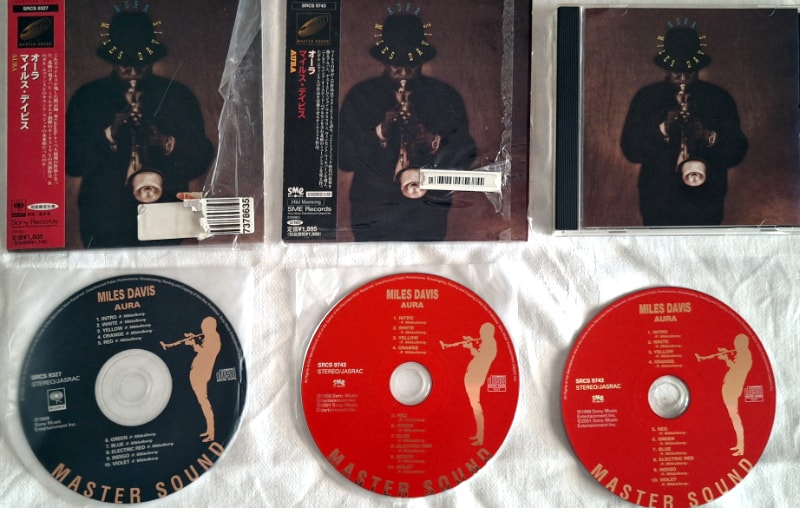
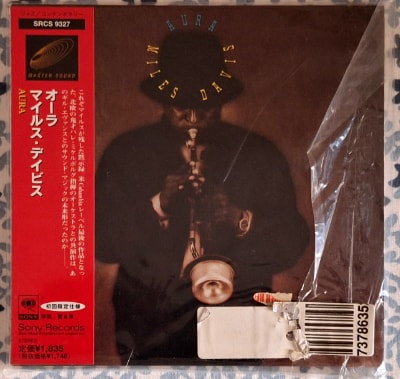
The original 1997 release had a red OBI strip and small cardboard replica of the LP version.
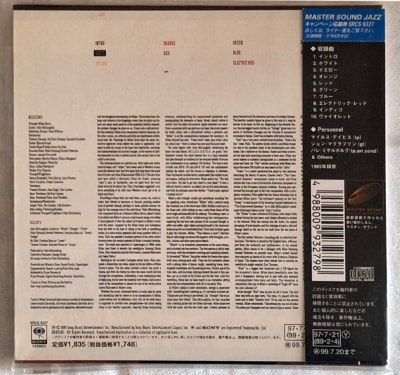
The back cover.
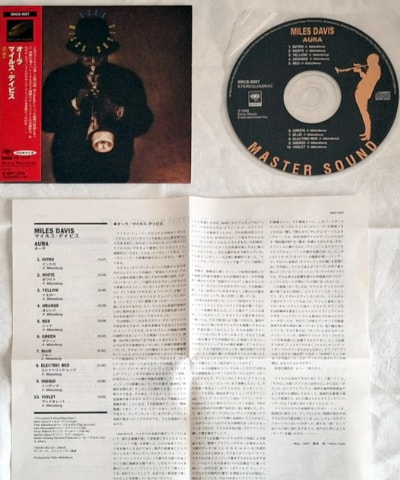
The disc contained a Japanese translation of the original liner notes.
A dozen facts about Aura:
- Aura won two Grammy awards in 1989, for Best Jazz Instrumental Performance, Soloist (on a Jazz Record) and Best Jazz Instrumental Performance, Big Band.
- It was during rehearsals for Aura that Miles met percussionist Marilyn Mazur, who later joined Miles’s band.
- The piece ‘White’ was not part of the original suite of songs from Aura. Before the start of the concert, Mikkelborg had played some background music on tape, which Miles had liked. When he was in the studio, Miles asked if the tape was available. Fortunately it was, and Miles recorded a solo over it.
- ‘White’ was used for the theme music for two major radio documentaries on Miles, The Miles Davis Radio Project and an eight-part BBC Radio 3 series, The Music Maker, which was presented by Ian Carr.
- Aura was remastered in 2000. The original release had a mastering error which wrongly combined the end section of ‘Green’ to the intro of ‘Red.’ Also, a new five-second horn intro was added to ‘Indigo.’
- Some of the Aura sessions were filmed and Danish TV broadcast a documentary, The Making Of Aura, which is on YouTube.
- Miles cited the refusal of Columbia Records to help finance the recording of Aura, and its reluctance to release the album as one of his reasons for signing with Warner Bros. in 1985.
- The piece ‘Green’ was written as a tribute to Gil Evans. It was only many years later that Mikkelborg discovered that Gil Evans’ original name was Gilmore Green.
- When John McLaughlin turned up at the studio, he had no electric guitar. A friend of Mikkelborg’s loaned him one.
- Palle Mikkelborg was reluctant to produce Aura, but was encouraged by Miles to do so. Miles was very pleased with Mikkelborg’s resulting work.
- The cover shot of Aura was taken from the photo session Miles had with photographer Gilles Larrain for the Decoy album cover.
- Miles does not play on ‘Indigo.’ He felt that pianist Thomas Clausen was playing enough music for the piece.
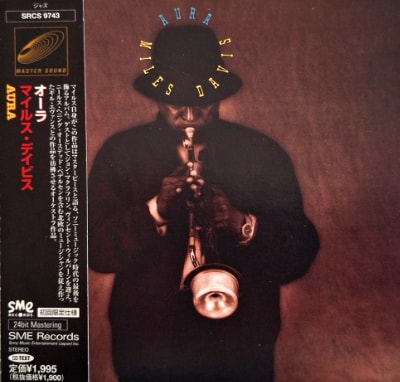
The 2001 Master Sound release had a mini LP cover with a black OBI strip.
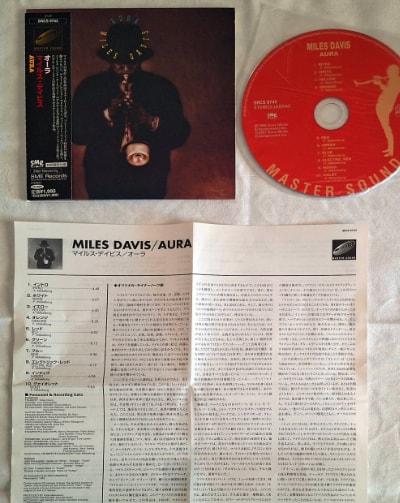
The 2001 disc and translation of the original liner notes.
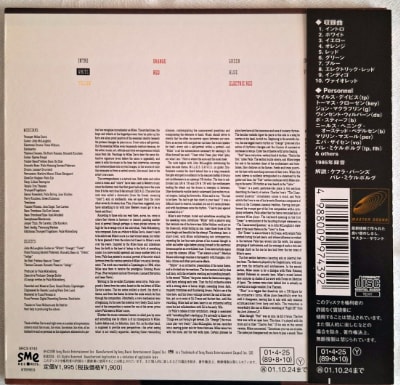
The back of the 2001 Master Sound CD cover.
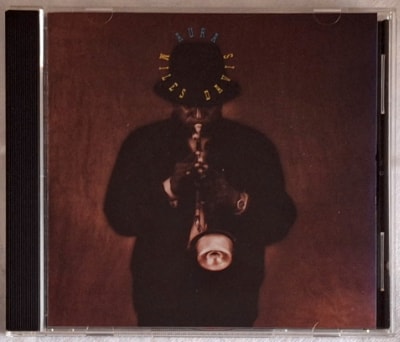
A second batch of the 2001 Master Sound release had a CD jewel case in place of the cardboard Mini LP cover.
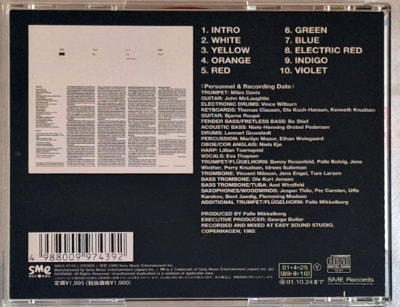
The back of the CD case also included a small image of the original liner notes.
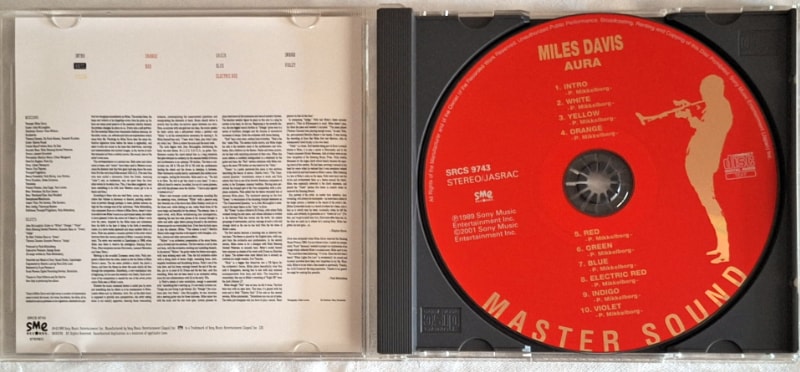
The CD Jewel case opened to reveal an alternative red label design.
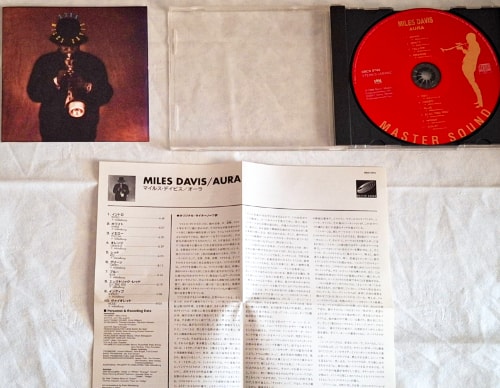
The disc and original liner notes translation.