The Last Miles

  • intro
  • albums
  • dvd
  • singles
  • other audio
  • books
  • gigs
  • cd
  • interviews
  • profiles
  • bands
  • memorabilia
  • photos
  • art
  • about

Miles Davis: Tutu – An Album Primer

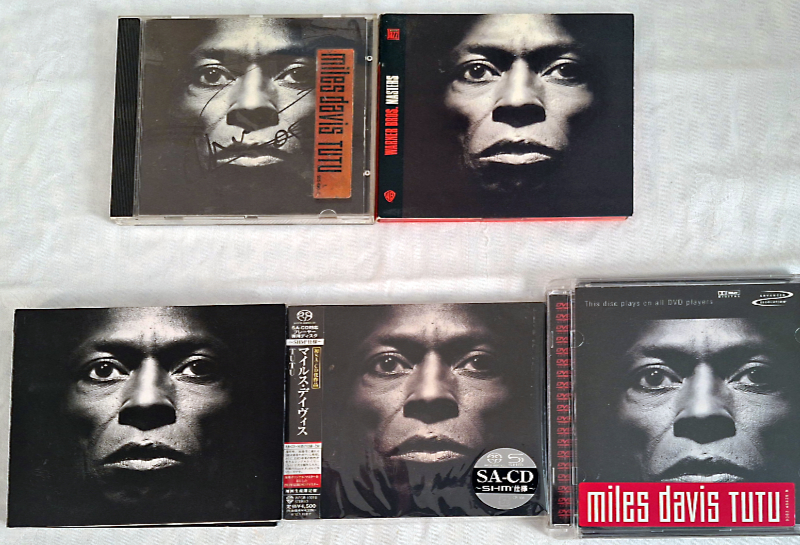
Tutu has appeared in various formats including standard CD (top row) and Deluxe, Super Audio CD (SACD) and DVD-Audio (DVD-A) formats (bottom row).

Background: In the summer of 1985, Miles ended a 30-year association with Columbia Records and signed with Warner Bros. Warner’s head of jazz was the acclaimed record producer Tommy LiPuma, and his role was to guide Miles on his first album for the label.

It’s fair to say that at this stage, neither Miles nor LiPuma had a clear idea on what direction to take. In September, Miles went into the studio with his band and recorded a couple of tracks that were a continuation of his You’re Under Arrest album (one of the tracks was ‘Maze’ a jazz-funk tune, and another was the pop hit ‘Broken Wings’ from the band Mr. Mister).

Miles also asked a number of musical associates to contribute potential songs, including Paul Buckmaster, Bill Laswell, Steve Porcaro of Toto (Miles had already recorded his tune ‘Human Nature’) and George Duke. Prince, who was also on the Warner Bros label, recorded a track for Miles. Miles also contacted guitarist/composer Randy Hall – they had worked together on The Man With The Horn. Hall and associate Zane Giles recorded around a dozen tunes with Miles, and the plan was to release an album called Rubberband.

Rubberband mixed jazz with pop and street-funk, but LiPuma did not think this was the direction for Miles to take. Around this time, Miles’s ex-bassist Marcus Miller (who was also a Warner Bros. artist) contacted LiPuma about the possibility of writing some material for Miles’s new album. LiPuma jumped at the chance and sent Miller a track they had already recorded, ‘Backyard Ritual,’ by George Duke.

This track was a mix of drum machines, samples and synths, with Miles adding his trumpet sound. On hearing the song, Miller realised that Miles was interested in moving in a new musical direction, one which embraced synthesisers, samplers, sequencers and drum machines. Back in New York, Miller contacted his long-time musical associate, keyboardist and programmer Jason Miles, who was working at the cutting-edge of synthesiser technology.

The two musicians crafted three demo tracks which combined rich, lush electronic soundscapes with Miller’s electric bass. Miller flew to Los Angeles to play the demos to LiPuma and Miles. Both men liked the music, and what’s more, Miles wanted to record his trumpet over the soundscapes Miller and Miles had created.

After completing the three tracks, Miller flew back to New York, assuming his work was done. Soon after, he was contacted by LiPuma, who told him that Miles wanted Miller to compose more songs for his new album. In New York, five more tunes (three of them composed by Miller) were recorded, and Tutu was completed.
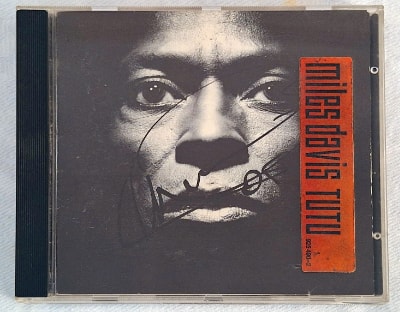
Front cover of the standard CD. The autograph is Marcus Miller’s!
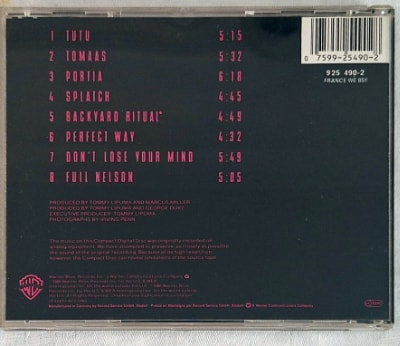
Back of the CD case.
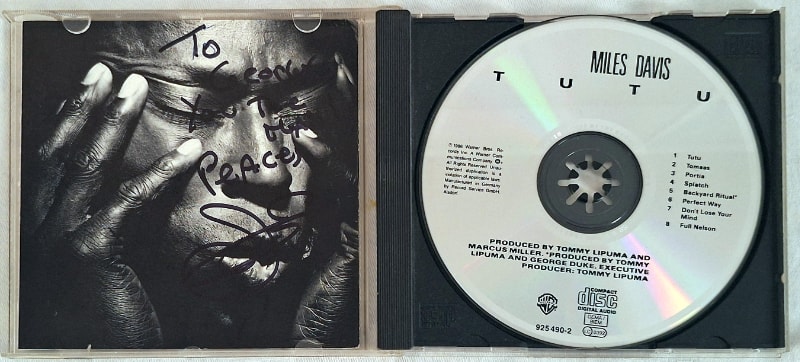
The standard CD silver CD and booklet. The autograph is Jason Miles’
The standard CD silver CD and booklet. The autograph is Jason Miles’!
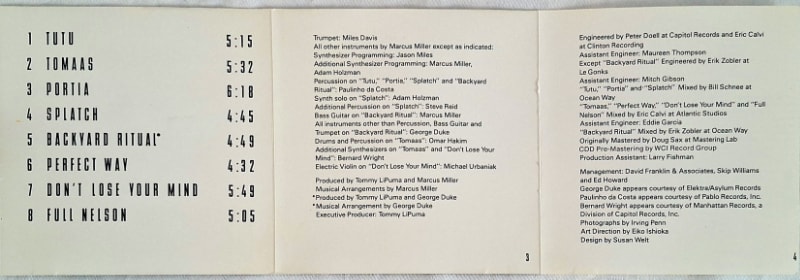
The CD booklet folded out to reveal track and credits information.

Tunes:

  1. Tutu
  2. Tomaas
  3. Portia
  4. Splatch
  5. Backyard Ritual
  6. Perfect Way
  7. Don’t Lose Your Mind
  8. Full Nelson

Producer: Tommy LiPuma, Marcus Miller, George Duke (track 5).
Recorded: February-March 1986.
Released: 1986.
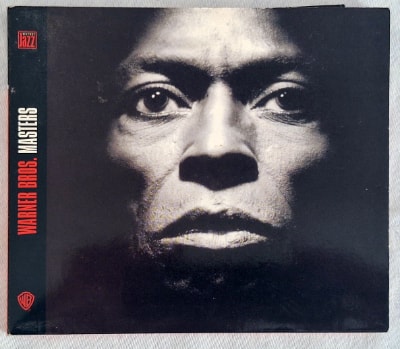
Sony Music released Tutu as part of its Masters series, with a cardboard digipak in place of a CD jewel case, and with new liner notes.
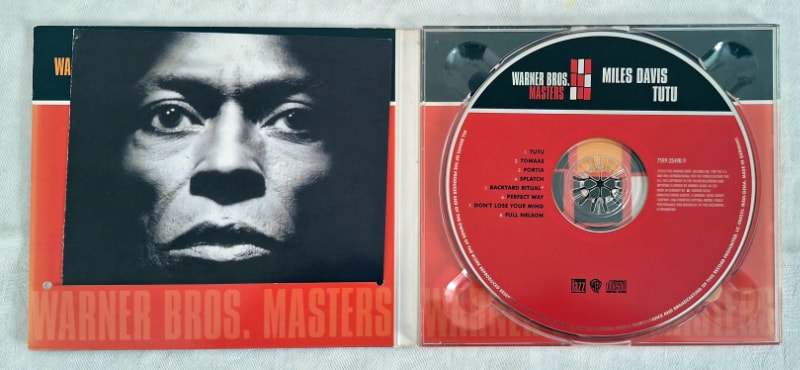
The CD booklet and label for the Masters release.
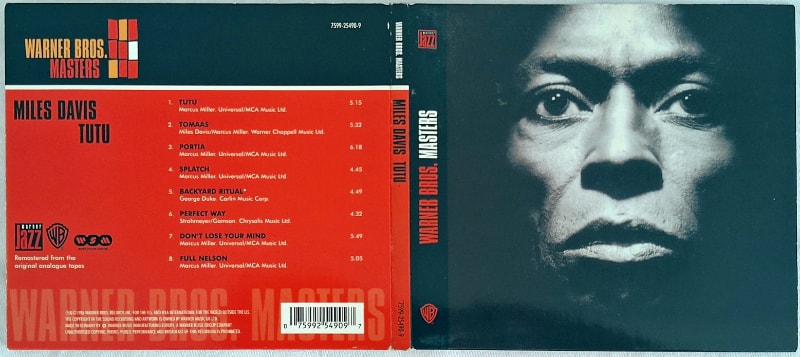
Front and back covers of the Masters Digipak.
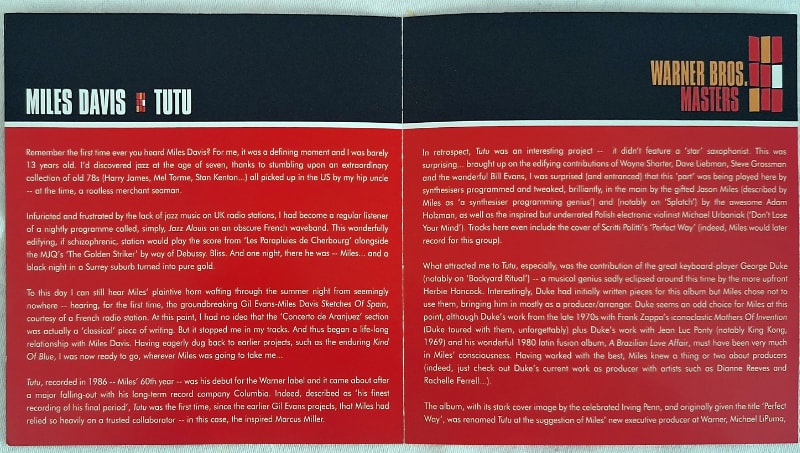
The liner notes were written by Chrissie Murray, who was editor of Jazzwise magazine at the time.

Musicians:

  • Miles plays trumpet on all tracks.
  • Marcus Miller plays fretted and fretless electric bass, bass clarinet, soprano sax, guitar, keyboards, and additional drums (on track 1).
  • Synthesiser programming: Jason Miles, Marcus Miller, Adam Holzman (track 4).
  • George Duke plays all instruments, except trumpet and bass on track 5.
  • Synthesisers: Adam Holzman (track 4), Bernard Wright (tracks 2 and 7).
  • Drums: Omar Hakim (track 2).
  • Percussion: Paulinho da Costa (tracks 1, 3, 4, 5); Steve Reid (track 4), Omar Hakim (track 2).
  • Electric violin: Michal Urbaniak (track 7).
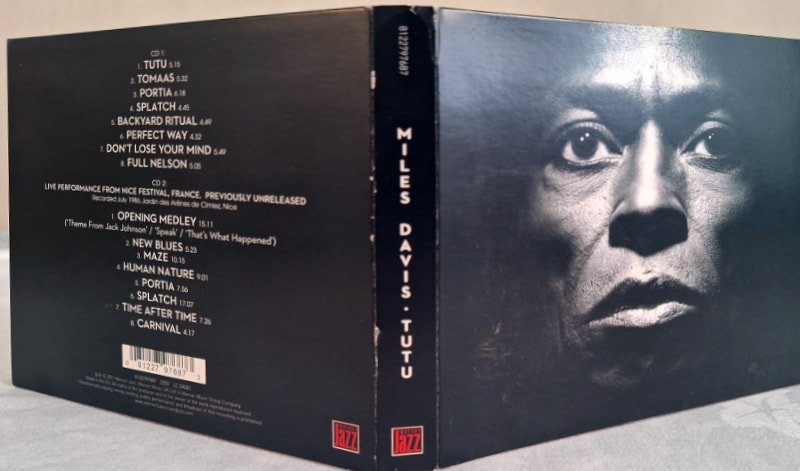
To mark the 25th anniversary of Tutu’s release in 2011, a double CD Deluxe version was released. It included the original CD plus a live concert from Nice in 1986. This shows the front and back covers.

The Tutu Deluxe digipak folded out twice – these are the outer covers.

The inside covers, including the green and mauve CD labels.
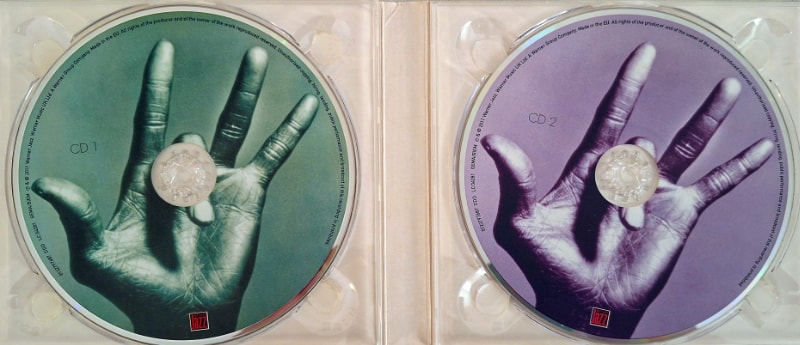
A close-up of the Tutu Deluxe CD labels.
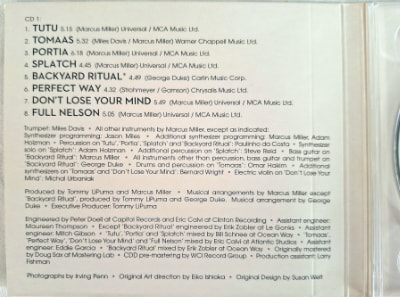
One panel provided information about the studio CD.
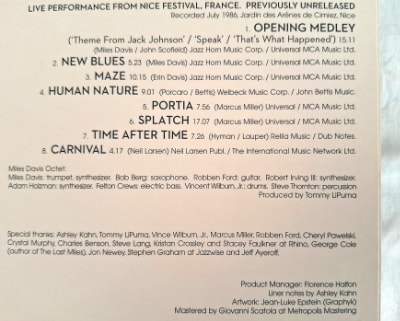
The other panel gave information about the Nice concert, including the two songs from Tutu.
The CD booklet cover.
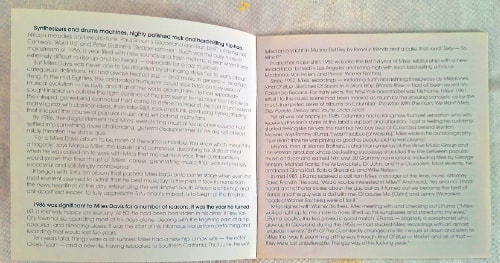
The Tutu Deluxe liner notes were written by writer Ashley Kahn.
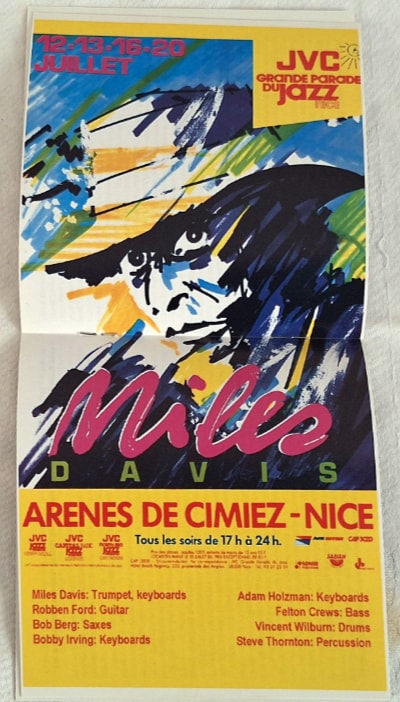
The booklet also included a miniature facsimile of the Nice concert poster.

A dozen facts about Tutu:

  1. Several of the tracks were named after people. The title track was named in honour of Archbishop Desmond Tutu, a leading anti-apartheid and human rights activist. ‘Tomaas’ was the name Miles used to call Tommy LiPuma. ‘Full Nelson’ is a tribute to both Nelson Mandela – the first black South African President and leading anti-apartheid activist – and Prince, whose full name was Prince Rogers Nelson.
  2. George Duke created his tune ‘Backyard Ritual’ using a synclavier, a combined drum machine, sampler and multi-track recorder. He included trumpet and saxophone samples on the demo he sent to Miles. Miles overdubbed his horn, but kept the saxophone sample in place, much to Duke’s disappointment, who referred to it as a ‘silly little saxophone sample.’ Many years later, Marcus Miller had saxophonist Alex Han play on the tune during his 2009/2010 Tutu Revisited tour. In 2011, Duke, Miller and saxophonist David Sanborn toured the US as a trio called DMS. In concert, Sanborn played the sax part on ‘Backyard Ritual.’ One presumes George Duke was happy about that!
  3. Miles played songs from Tutu extensively in concert throughout his remaining years. In some concerts, half a dozen songs would be from Tutu. In his final concert on 25 August 1991 at the Hollywood Bowl, ‘Perfect Way’ was the concert opener.
  4. The only song from Tutu that Miles never played live was ‘Backyard Ritual.’ ‘Tutu’ was played live more than 260 times, while ‘Don’t Lose Your Mind was only played four times in concert (statistics courtesy of miles-davis.de).
  5. Marcus Miller included a handful of guest musicians on Tutu, including drummer Omar Hakim and keyboardist Bernard Wright. Both were childhood friends of Miller from Jamaica, Queens, in New York. That area was a hot-bed of musical talent and drummer Lenny White also grew up there!
  6. Omar Hakim also played on the other two albums that Miles and Marcus Miller worked together on: Siesta and Amandla.
  7. Commenting on the music on Tutu, keyboardist Kei Akagi – who played with Miles in 1989–90 – and later became professor of music at the University of Los Angeles, says: “This music has influenced a generation of younger musicians, who now treat Tutu as having the same significance as ‘So What.’”
  8. Prince submitted a track, ‘Can I Play With U,’ for Miles, who overdubbed his trumpet part (Miller and Holzman also added bass and keyboard parts respectively). But Miles and Prince weren’t happy with the resulting track, and so it was left off Tutu. ‘Can I Play With U’ was finally officially released in 2020 on Prince’s Sign O‘ The Times Super Deluxe Edition boxed set.
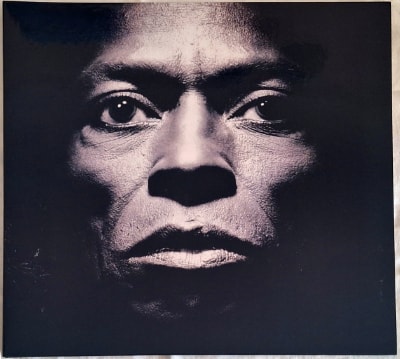
  9. The stunning cover shot of Miles was taken by celebrated American portrait and fashion photographer Irving Penn, whose previous subjects had included Alfred Hitchcock, Picasso and the Duchess of Windsor. Writer Steve Fairclough has written an excellent feature on the background to the shooting of the Tutu cover.
  10. Tutu won two Grammys in 1987: for best jazz instrumental performance and best recording package.
  11. The beautiful ensemble ending on ‘Portia’ was not part of the original composition. It was Miles who suggested it to Miller whilst they were in the studio, stating that it would complete the song.
  12. The only cover song on the album is Scritti Politti’s ‘Perfect Way,’ which was Miles’s suggestion. In fact, he was considering making it the title track. Miles later developed a good friendship with the band’s singer Green Gartside. Miles played on Scritti Politti’s ‘Oh Patti (Don’t Feel Sorry For Loverboy)’ from the 1988 album Provision, and even appeared on the song’s video. The album had a strong Tutu connection – it also featured contributions from Marcus Miller and Jason Miles.
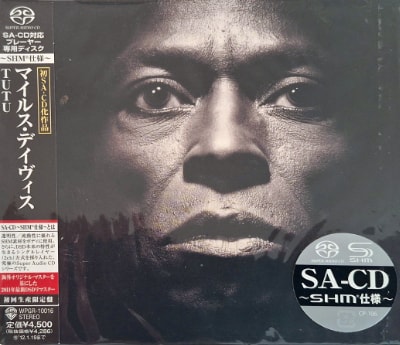
Cover of the SACD version of Tutu.
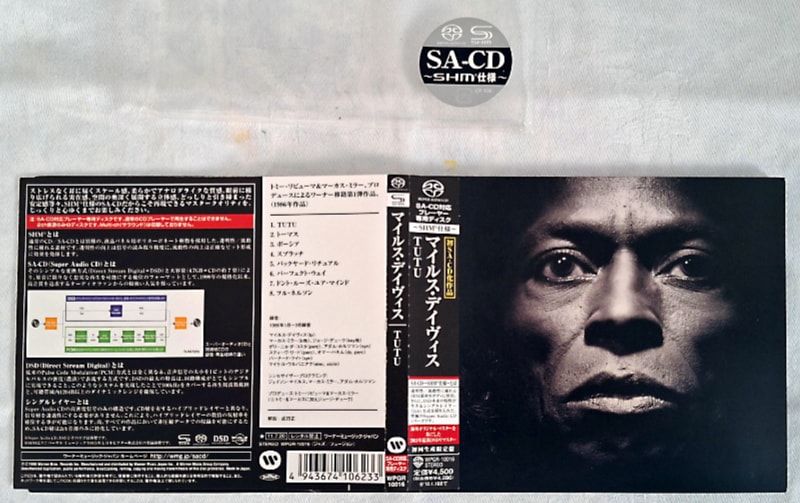
Cover and back – the release has a very large OBI strip with covers the back of the case.
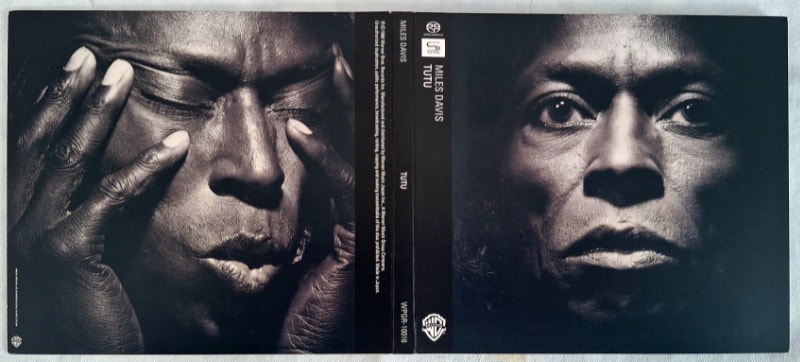
Front and back with OBI strip removed.
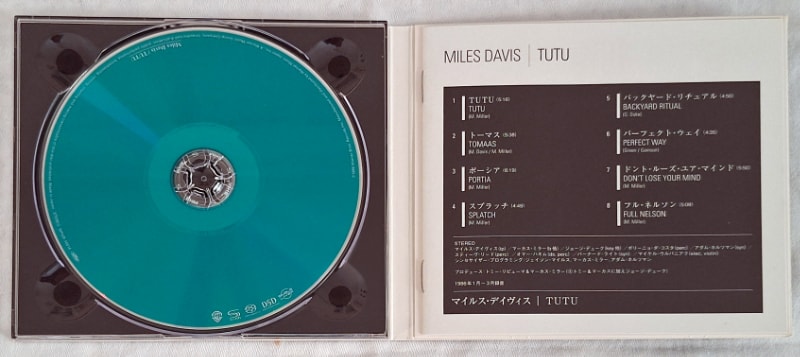
Inside the cover is the unusually coloured CD and booklet, which is attached to the CD case.
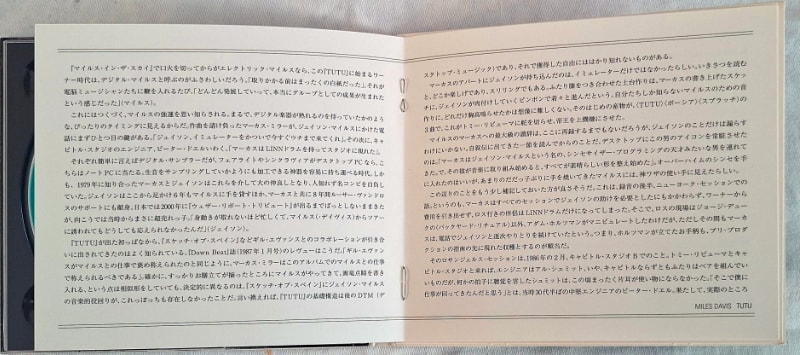
The liner notes by Tadashi Narita are informative and he makes a point of praising the work done by Jason Miles on the album.

Close-up of the rear OBI strip.
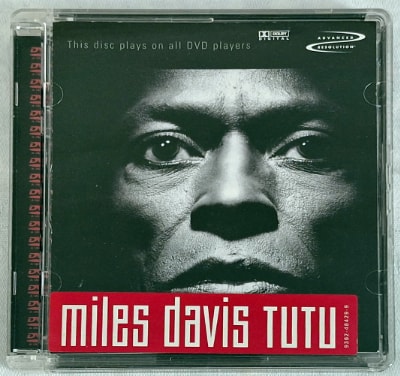
Tutu was also released in the now defunct DVD-Audio format. The release comes with both multi-channel and stereo mixes. The stereo mix is created by down-mixing the multi-channel mix, and as a result, there are some differences in sound from the standard CD mix.
Tutu was also released in the now defunct DVD-Audio format. More on the format and this release here. The release comes with both multi-channel and stereo mixes. The stereo mix is created by down-mixing the multi-channel mix, and as a result, there are some differences in sound from the standard CD mix. The link also provides details on this.
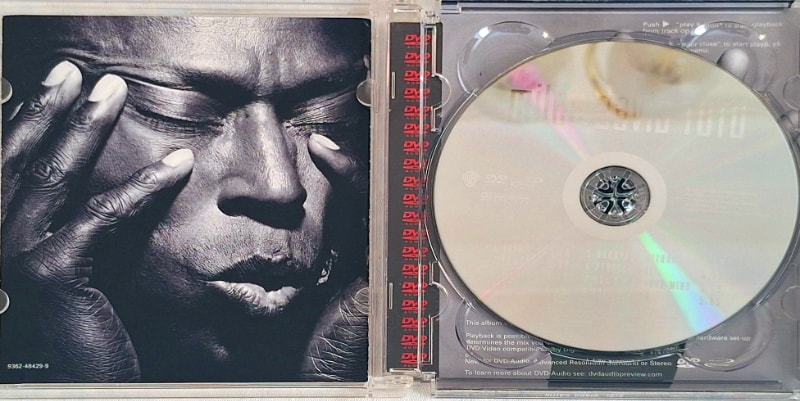
The disc comes in a strong, Super Jewel Box CD case, which is larger than a standard CD. This is the inside, with disc and booklet.
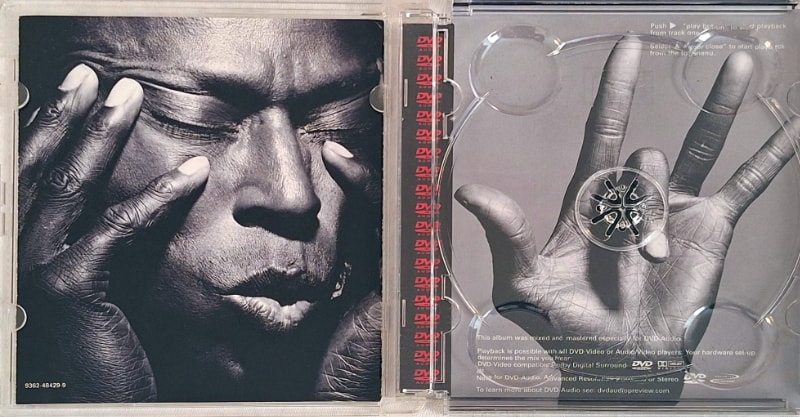
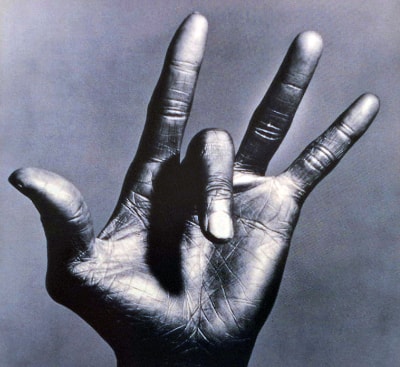
The DVD-A case has a nice inlay image of Miles’s hand from the Tutu back cover.
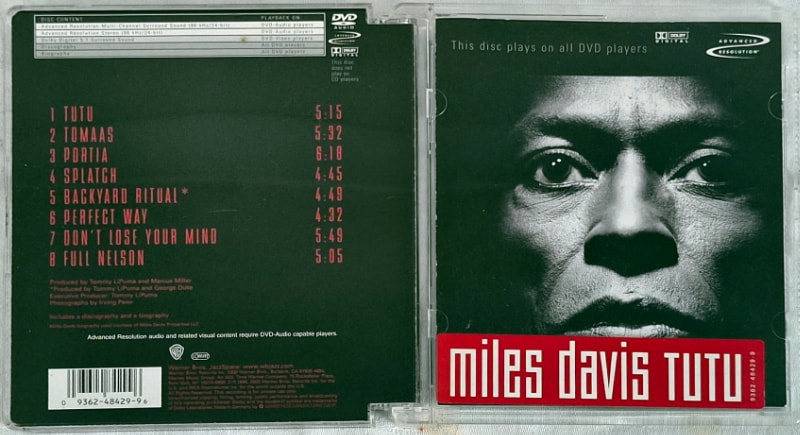
Front and back case covers.
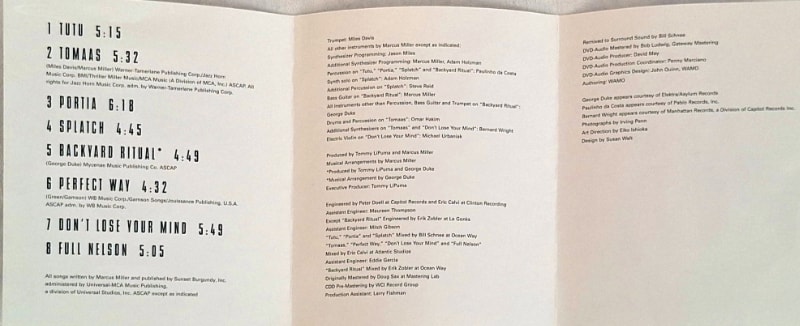
It offers the same information as the original CD release, with additional information available to be read on a TV screen.
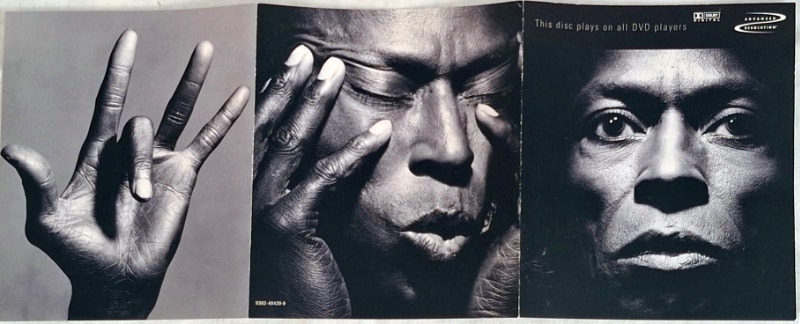
The booklet folds out to reveal three striking images, all taken by Irving Penn.

Tutu LP Editions:
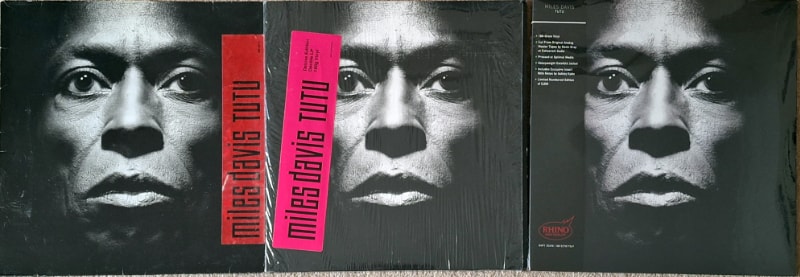
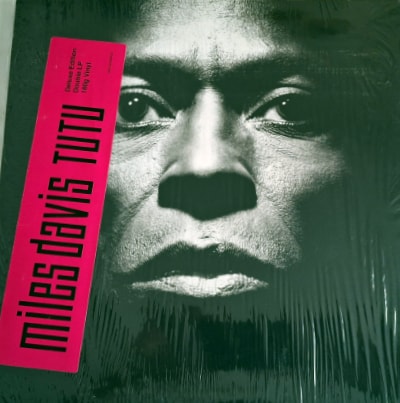
Various editions of Miles Davis’ ‘Tutu’ on vinyl.
There are various LP versions of Tutu including (left to right), the standard album release; The Deluxe version, released in 2015, and the High Fidelity version, released in 2024.
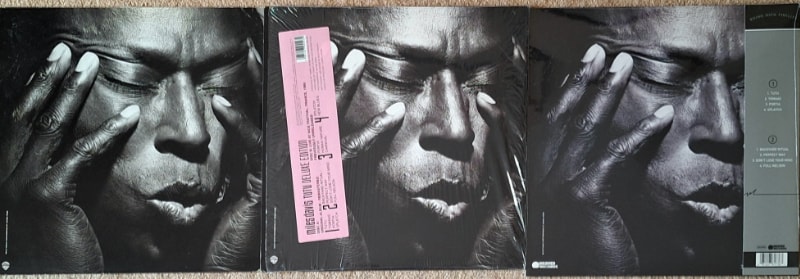
Back covers of Miles Davis’ ‘Tutu’ on vinyl.
The back covers of the various LP releases.
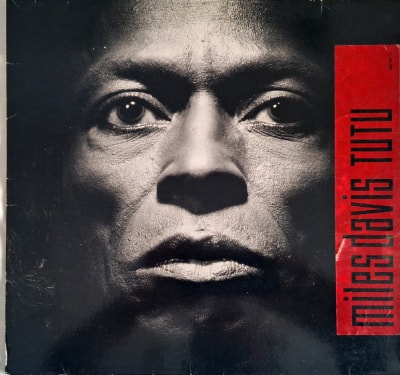
The standard cover of Miles Davis’ ‘Tutu’ on vinyl.
The standard version cover shows the stunning portrait of Miles by photographer Irving Penn. The red sticker was added to identify the album and artist.
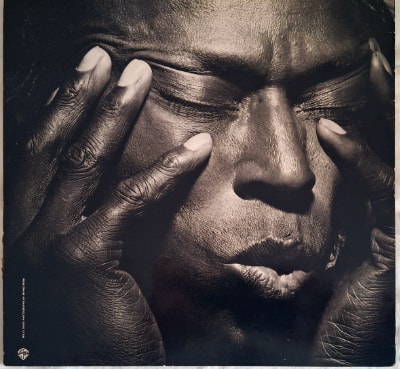
The standard back cover of Miles Davis’ ‘Tutu’ on vinyl.
The back cover of the standard version. This also included a sticker with track and time information, but it is missing here.
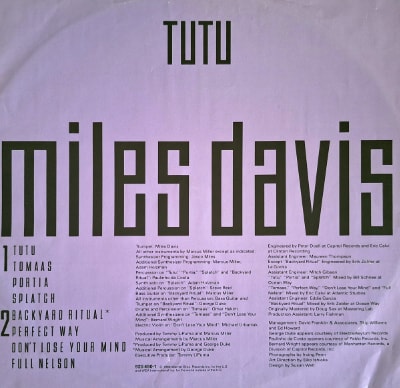
A paper inner sleeve of Miles Davis’ ‘Tutu’ on vinyl.
One side of the paper inner sleeve contains track and credit information.
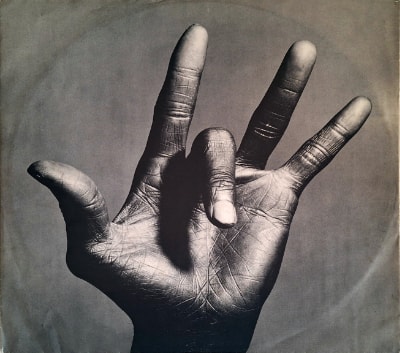
A paper inner sleeve of Miles Davis’ ‘Tutu’ on vinyl.
The other side of the inner sleeve has a striking close-up of Miles’s left hand.
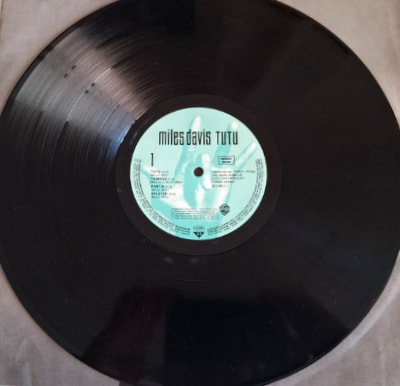
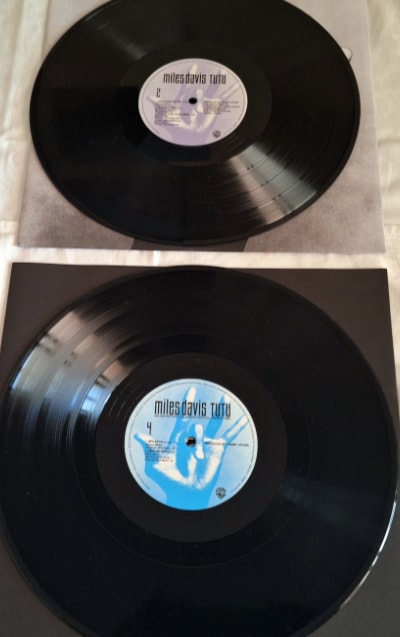
A label from Miles Davis’ ‘Tutu’ on vinyl.
Side A of the disc has a light green label.
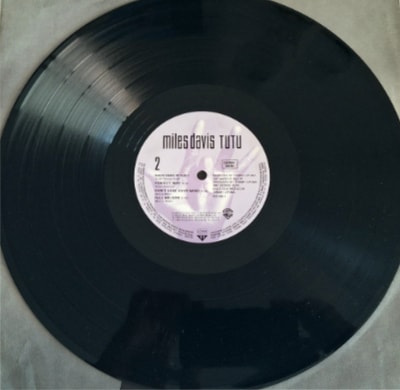
A label from Miles Davis’ ‘Tutu’ on vinyl.
Side B has a mauve label.
The Deluxe version of Miles Davis’ ‘Tutu’ on vinyl.
Tutu Deluxe was originally only released on CD, but the rebirth of the vinyl record saw an LP version emerge in 2015, which has two discs pressed in high quality 180g vinyl. It contains the original studio version of Tutu, and a live concert from Nice in 1986.
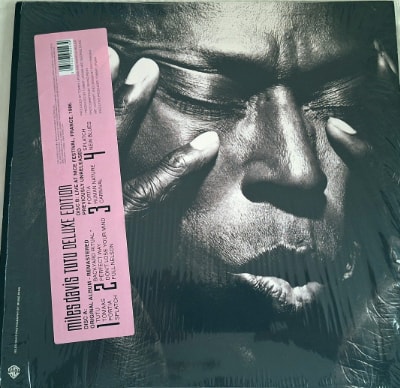
The Deluxe back sticker of Miles Davis’ ‘Tutu’ on vinyl.
The back sticker gives the track listings for the four sides.
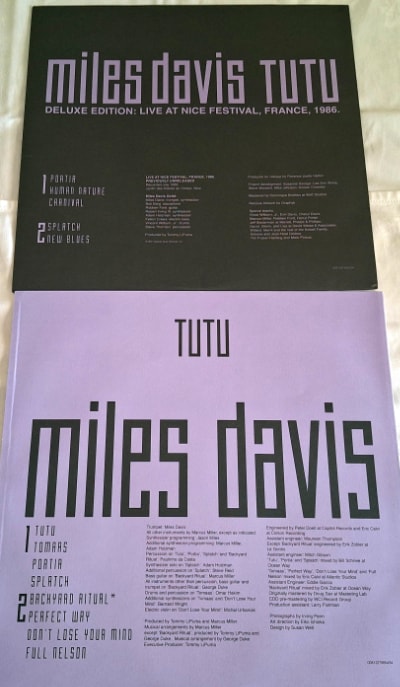
The Deluxe inner sleeve of Miles Davis’ ‘Tutu’ on vinyl
The inner sleeve for the studio album is the same as for the standard release. The sleeve for the Nice concert gives track and personnel information.
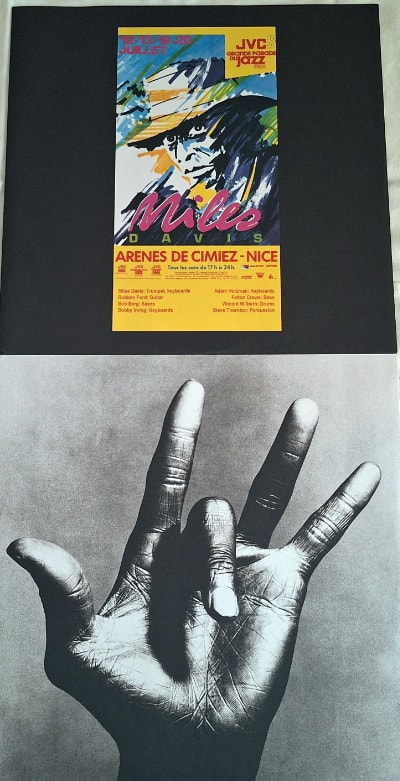
The Deluxe inner sleeve of Miles Davis’ ‘Tutu’ on vinyl.
The other sides of the inner sleeves. The Nice album sleeve has a facsimile of the concert poster.
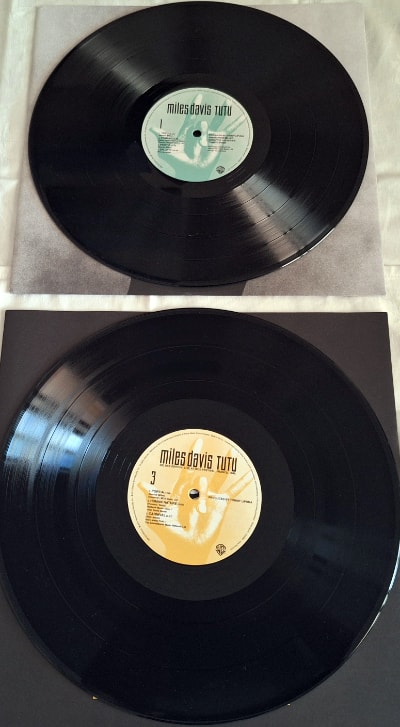
The Deluxe label of Miles Davis’ ‘Tutu’ on vinyl.
The labels for sides 1 and 3.
The Deluxe label of Miles Davis’ ‘Tutu’ on vinyl.
The labels for sides 2 and 4.
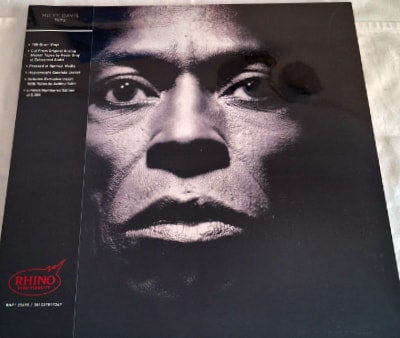
The High Fidelity version of Miles Davis’ ‘Tutu’ on vinyl.
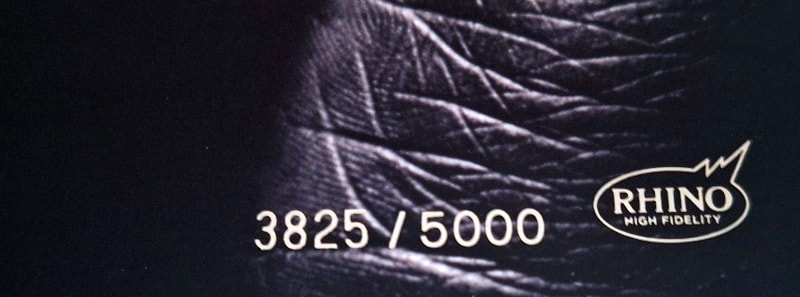
In 2024, Warner Bros. subsidiary Rhino released a High Fidelity version of Tutu. It is pressed in 180g vinyl and cut from the original analogue master tapes. The pressing is limited to 5000 copies and each album is numbered.
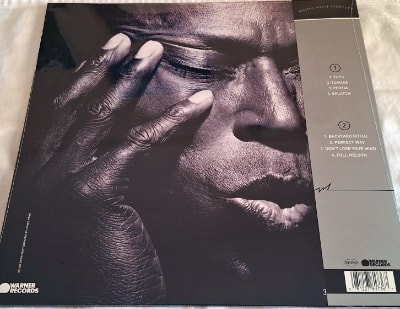
The High Fidelity back cover of Miles Davis’ ‘Tutu’ on vinyl.
The back cover of the High Fidelity version.
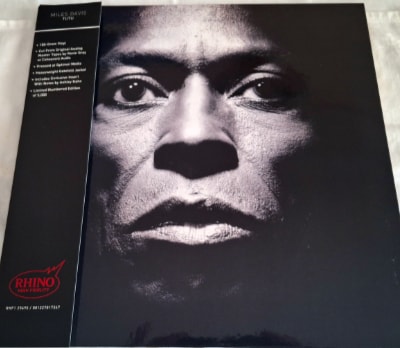
The High Fidelity OBI strip of Miles Davis’ ‘Tutu’ on vinyl.
The LP has an OBI strip, normally seen on Japanese CD releases.
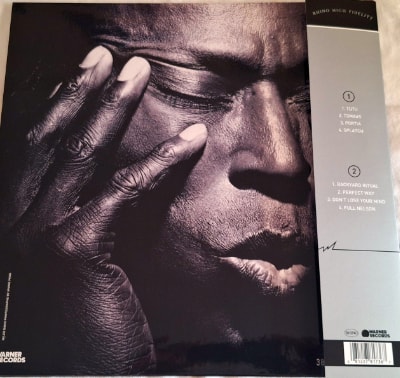
The High Fidelity OBI strip of Miles Davis’ ‘Tutu’ on vinyl.
The back of the OBI strip.
The High Fidelity front cover of Miles Davis’ ‘Tutu’ on vinyl.
Album front cover with OBI strip removed.
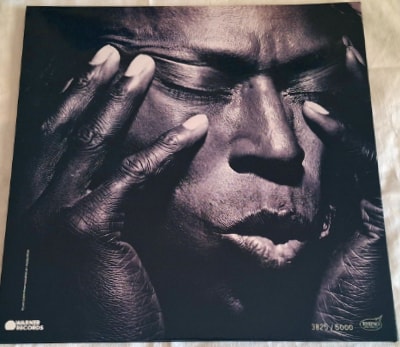
The High Fidelity back cover of Miles Davis’ ‘Tutu’ on vinyl.
Album back cover without OBI strip.
The High Fidelity numbered label of Miles Davis’ ‘Tutu’ on vinyl.
Each High Fidelity release in individually numbered.
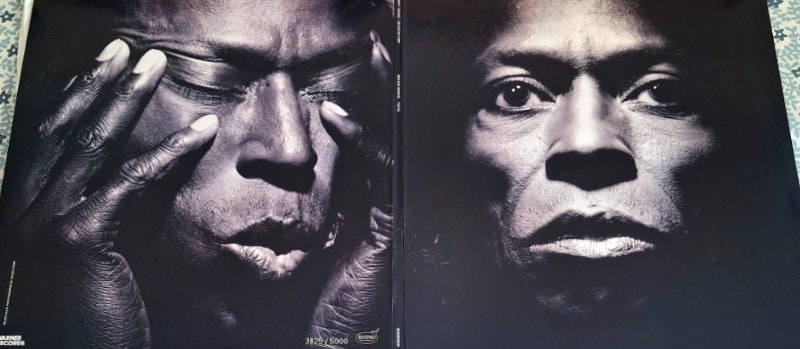
The High Fidelity gatefold sleeve of Miles Davis’ ‘Tutu’ on vinyl.
The High Fidelity comes in a special gatefold sleeve. These are the front and back covers.
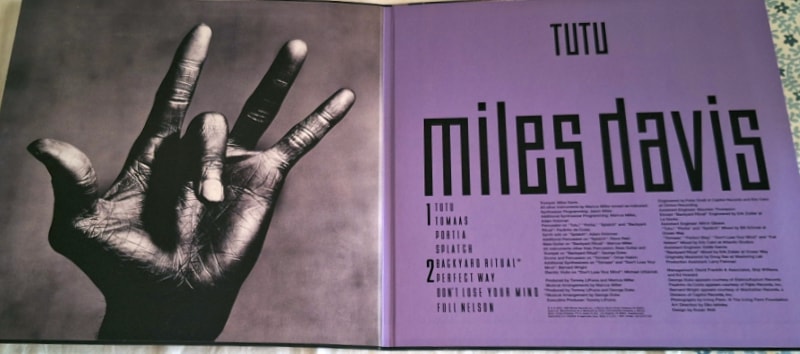
The High Fidelity inside covers of Miles Davis’ ‘Tutu’ on vinyl.
The inside covers show both sides of the original album inner sleeve.
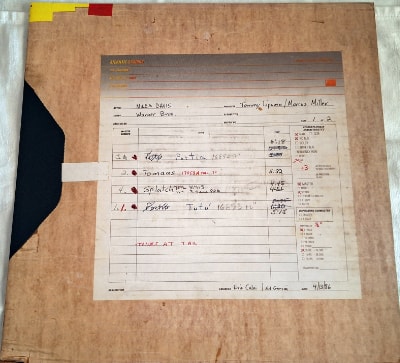
The High Fidelity insert of Miles Davis’ ‘Tutu’ on vinyl.
The album comes with a special four-page insert. The front cover shows the original studio master tape box documentation, with track, time and track running order for Side A, written by engineer Eddie Garcia on 13 April 1986.
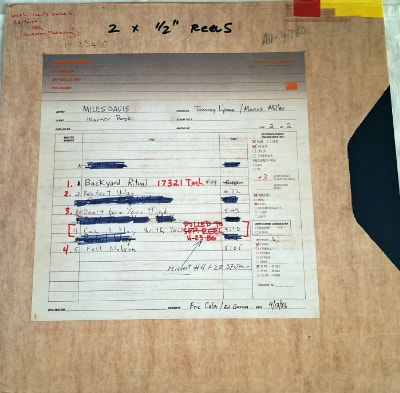
The High Fidelity insert of Miles Davis’ ‘Tutu’ on vinyl.
The back of the insert shows the documentation for Side B and it contains some interesting information. First, it reveals that the original analogue master tapes were baked in order to preserve them. Over time, humidity causes magnetic tape binder to break down, and when the tape is played, it leaves a sticky residue on the tape heads. This gunge can damage the master tape. The remedy is to bake the master tape for around eight hours and then transfer the recording onto another medium. This process can only be carried out once. The notes also show that Side Two of Tutu was originally planned to include five tracks rather than the four on the eventual release. The original track running order was: ‘Backyard Ritual’/’Perfect Way’/’Don’t Lose Your Mind’/‘Can I Play With U?’ [written as ‘Can I Play With You’]/ ‘Full Nelson.’ ‘Can I Play With U?’ was the song Prince had written and recorded for Miles. But both artists weren’t happy with the resulting track and it was pulled. It was eventually released in 2020 on the Sign ‘O Times Deluxe boxed set. That version runs for 6.39, but the version originally planned for Tutu was edited down to 4:10. Various bootleg versions of ‘Can I Play With U’ have emerged, each with varying running times. The bootleg album series The Work Volume 2 (Disc 2) (released in 2001) has a 4:09 version of ‘Can I Play With U?’ but whether this is the same as the 4:10 edit selected for Tutu is unclear. It’s also unclear whether Prince or someone else edited the track.
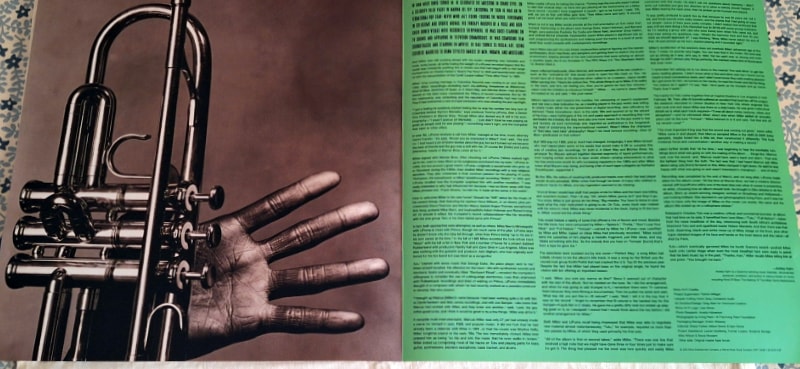
The High Fidelity insert of Miles Davis’ ‘Tutu’ on vinyl.
The inside of the insert includes a previously unused photograph taken by Irving Penn during the Tutu photo session, and liner notes by writer Ashley Kahn.
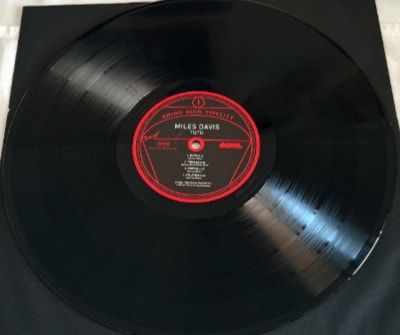
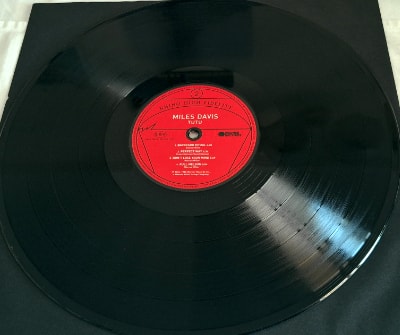
The High Fidelity label of Miles Davis’ ‘Tutu’ on vinyl.
The label for Side 1 of the High Fidelity release.
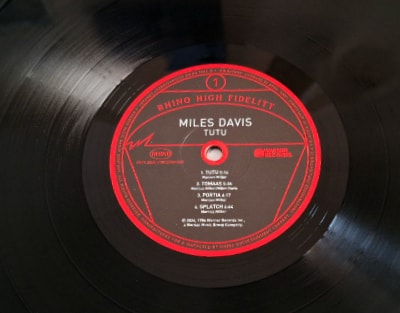
The High Fidelity label of Miles Davis’ ‘Tutu’ on vinyl.
Close-up of Side 1 label.
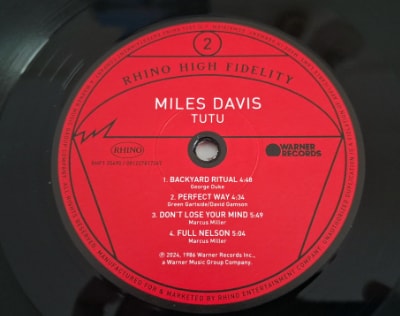
The High Fidelity label of Miles Davis’ ‘Tutu’ on vinyl.
Side 2 record label.
The High Fidelity label of Miles Davis’ ‘Tutu’ on vinyl.
Close-up of Side 2 label.

There’s lot more information about Tutu in the Interviews section:

  • Marcus Miller talks about Tutu.
  • There’s a profile of Jason Miles.
  • Peter Doell, who engineered the Los Angeles sessions, recalls his time in the studio with Miles, Marcus Miller and Tommy LiPuma.
  • Eric Calvi, who engineered the New York sessions, and mixed five of the tracks, talks about working with Miles, Marcus Miller, Jason Miles and Tommy LiPuma.
  • Recording engineer Eric Calvi revisits Tutu.
  • Producer and mixing engineer Bill Schnee describes how he mixed the Los Angeles recordings.
  • Green Gartside talks about Miles.
  • For details of how Prince and Miles worked on ‘Can I Play With U’, interviews with Alan Leeds, Prince’s tour manager at the time, and his brother Eric, who was in Prince’s band and also recorded some saxophone on the track, can be found here: part one and part two.
The Last Miles: The Music Of Miles Davis 1980-1991: UK editionUK edition

The Last Miles:
The Music of Miles Davis
1980-1991

A Book by George Cole

The Last Miles is published by Equinox Publishing in the UK and the University of Michigan Press in the USA.

The Last Miles: The Music Of Miles Davis 1980-1991: USA editionUSA edition


Buy online from
click to buy at Amazon.co.uk
and in the USA from
Click to buy at Amazon.com

Contact George Cole at

The Last Miles

  • intro
  • albums
  • dvd
  • singles
  • other audio
  • books
  • gigs
  • cd
  • interviews
  • profiles
  • bands
  • memorabilia
  • photos
  • art
  • about

praise for The Last Miles

“The best Miles Davis book ever.” Randy Hall, singer/guitarist/producer, who worked with Miles in the 1980s

“An important book.” Brian Priestley, co-author of ‘The Rough Guide to Jazz’, jazz pianist, critic and reviewer

“Very moving, emotional material.” Gordon Meltzer, Miles’s last road manager and executive producer of the ‘Doo-Bop’ album

“George Cole’s writing, his choice of references, his descriptions of many incidents – it is all so clear and respectful, and shows a deep understanding.” Palle Mikkelborg, composer, arranger and producer of the ‘Aura’ album

“Wow! What a great book. Finally, something that really gets it right. Thank you for capturing what was going on, the mood, everything.” Adam Holzman, Miles’s keyboardist and musical director 1985-1989

“Wonderful job, congratulations! An immense amount of work must have gone into it, I can't even imagine. But it was very cool to see that era of Miles treated with the same respect as every other… someone gets it!” Benny Rietveld, Miles's bassist 1988-1990

“The book is wonderful. Congratulations for your very important contribution to the historical documentation of many [musicians] who would otherwise have been overlooked!!!!” Robert Irving III Miles’s musical director 1983-1988

“I have to say that you did a marvellous job! It brought back strong memories of that time periodand answered a number of questions I had, especially the chapter on the Rubberband sessions. A brilliant job!” Patrick Murray, who worked on the road with Miles from 1986-1990 and was Miles’s concert sound mixer from 1988-1990

“It is truly an excellent body of work that literally takes a reader from hearing rumours to realising truths about the Chicago group and our collective take on the Miles Davis comeback.” Glenn Burris, co-writer of "Shout"

“The most immediate impact that this book had on me was to make me listen again to Miles’ later recordings with a completely regenerated ear and this really is the reason why this book works so well and is an essential read for any true Miles Davis appreciator… you will be hard pressed to find a more inspirational read, written by a man who quite simply loves Miles Davis’ music.” Mike Chadwick, Ejazz.fm

“There are large chunks of fresh material here… Fill[s] in quite a few gaps and dismisses blanket condemnations of [Miles’s] pop phase.” Stephen Graham, Jazzwise

“Cole does for Miles’ late work what Ian Macdonald’s ‘Revolution In The Head’ does for The Beatles, examining each album in meticulous detail.” John Lewis, Time Out

“Cole’s analysis has a meticulous, forensic character… [and] is able to bring a wealth of new information to light…. This book should get people talking. It should be the first rather than the last word on an intriguing chapter of the life an extraordinarily complex artist. And Davis’s vanity would surely have loved that.” Kevin Le Gendre, Independent on Sunday

“The book is beautiful. I think you did a great job on covering Miles’s life and legacy.” Sid Reynolds, hip-hop producer

“GREATFUCKINJOBWITDABOOK” Foley, Miles’s lead bassist 1987-1991

“Cole’s certainly produced a fascinating book.” Chris Ingham, Mojo

“As with any good musical biography, Cole had made me think again about those albums such as Siesta, You’re Under Arrest, The Man with the Horn, that are now stashed in my attic.” John Bungey, The Times

“I thought it was wonderful. It’s a very detailed look at a certain part of the career and life of Miles Davis. A lot of people didn’t pay attention to this and I’m glad that George Cole took the time to focus on these final years of Miles’s life.” Easy Mo Bee, co-producer of Doo-Bop

“Many people have come to me in the past about how the "last miles” bands had been overlooked and ignored by journalists. This book is a comprehensive answer to these omissions. From my discussions with musicians from the latter years with Miles it seems pretty clear they feel some vindication as a result of this book. I thank you sincerely for telling our story. Most everything I have read is as close to my memory of how things happened as any book could hope to be. I think you've done a wonderful job.” Darryl Jones, bassist with Miles 1983-85, 1986-1988

“The title is likely to send most jazzbos running, with received wisdom having handed down the rule that in the 80's Miles was only good for playing live; and half of that was just the pleasure of seeing him in person. For a single man to take on the 400-page+ task of changing popular opinion is a very tall order indeed. For him to make you want to actively revisit the decade in question is a near-miracle. Detailing album histories and giving final verdicts, Cole has made every effort to lay the evidence out bare. The analysis could have been a chore were it not for the presence of first-hand interviews with all the major players, making this not just a scholarly study, but a tribute to the man himself, And for a book such as this, you learn more about Davis that could have been expected.” Jason Draper, Record Collector

“There simply hasn’t been another book published on Miles Davis, in any period that has managed to obtain the wealth of interview material and cover his recorded work and various live tours in such a complete and comprehensive fashion… Engagingly written from start to finish, filled with more facts than you’ll be able to remember first time through, The Last Miles is an essential portrait of Miles’ last decade and a strong argument that his music was both valid and perfectly in keeping with a musical philosophy that would ultimately stretch over six decades.” John Kelman, All About Jazz.com

“We veterans of Miles’ last bands are lucky to have such a thorough and insightful look into Miles last period… I really enjoyed the book!” John Scofield, Miles's guitarist 1982-1985

“Cole has spoken to practically everyone who worked with Miles in his final decade. He has traced the evolution of each of those final albums, cut by cut, splice by splice….[Miles] comes out of Cole’s account larger, warmer and if anything even more important than ever.” Brian Morton (co-writer of The Penguin Guide to Jazz), The Wire

“Through lively analyses of all Miles’ recorded work from this period and much that went unreleased, including the ‘lost’ album Rubberband, [Cole] does enough to send readers back to the original albums.” Simon Evans, Choice

“… Cole is a persuasive writer: he prompted me to go and dig out albums that I'd dismissed as inconsequential and listen again with fresh ears. … A rewarding read.” Charles Waring, Blues & Soul

“Cole takes us on an exhaustive journey deep into the heart of Miles’ late recordings… The Last Miles needs to be covered by working musicians, producers and Miles’ fans alike.” Livingstone Marquis, Straight, No Chaser

“ George Cole has written a book that should be required reading for anyone with a serious interest in Davis’ life and work irrespective of which period of his music you prefer. It offers a valuable insight into this most complex of personalities, and reveals a side to Miles that many may not have known existed…for this reader it has prompted a re-examination of this decade which has revealed a fascinating area of music that I had previously overlooked.” Nick Lea, Jazzviews.co.uk

“In the flurry of books since [Miles Davis's] death, none has dealt in depth with the music of this period. Music writer George Cole fills this gap… It is so detailed and intimate that the reader feels he is virtually living with Davis as he seeks to reinvent himself… a rich and rewarding read.” Irwin Block, The Montreal Gazette

“This is a must for every Miles fan.” Neal Gardner, Blogcritics.org

“A fantastic book, an amazing insight into Miles.” Guy Barker, jazz trumpeter

The Last Miles US edition
Buy from Amazon.com
The Last Miles UK edition
Buy from Amazon UK

“For Miles fans, this book is a must.” Jez Nelson, presenter BBC Radio Jazz on 3

“I really do recommend The Last Miles… it is a fine work.” John Cavanagh, presenter Radio Scotland’s Bebop to Hip-Hop

“A great book that plays a great tribute to the last years of Miles’ life.” Erik Telford, presenter Miles Radio.com

“The fact of having personally interviewed all those characters… without much recall to interviews already noted and the usual anecdotes, renders “The Last Miles” as excellent… a book that certainly is seen as a work of reference.” Maurizio Comandini, All About Jazz.com Italy

“[Cole] has written a comprehensive account of the comeback and the albums it produced… He takes the reader through each of the albums, cut by cut, examining the musical choices, the musicians and their successes… Cole's book is a valuable resource on the last 11 years of a true music legend's life.” Chris Smith, Winnipeg Free Press

“I've been thoroughly enjoying your book. I'm sure it'll go a long way towards rectifying some of the negative historical appraisals of Miles' later works that have become prevalent.” Kei Akagi, keyboardist in Miles's band 1989-1990.

“Cole gives an exhaustive account of every track recorded [and, it seems, every live show] in that decade and of every one of the dozens of musicians who played on them but what's most interesting is the portrait of Miles Davis that emerges from it all. Sometimes an asshole and a bully, yes, but also a very funny guy who was a good friend to many and a mentor to even more, a man with drug problems who was more often in great pain from other maladies. Through it all, Davis was obsessed with moving his music forward with anyone who could help him do it - from Prince to Public Enemy, from Scritti Politti to a violinist he saw on Johnny Carson and hired on the spot.” Rock & Rap Confidential

“I thought your book was awesome and straight to the point. To tell stories the way it really happened is nothing but the truth! Congratulations and thanks!” Ricky Wellman, Miles's drummer 1987-1991

“George Cole has made a major contribution to jazz scholarship… written over a three-year period, the degree of detail is quite astonishing and the research so extensive that it becomes possible to contradict claims made by Miles himself in his autobiography. Every track on every 1981-1991 album is discussed in length… a very valuable book.” Chris Yates, The Jazz Rag

“This book is a model of how these types of books should be… If late period Miles is in the readers’ interest, the reader should rush out and purchase this volume. It is invaluable.” Robert Iannapollo, ARSC Journal

The Last Miles was voted one of the top ten music books of 2005 by Record Collector magazine.

The Last Miles was joint winner of the Association for Recorded Sound Collections’ Best Jazz History Book 2006 award.

© 2004–2026 TheLastMiles.com. All Rights Reserved.