Interview date: 13 May 2026
Recording and mixing engineer Eric Calvi has worked with many major jazz artists including, George Benson, Earl Klugh, David Sanborn, Kenny Garrett and Grover Washington Jr. His diverse portfolio also includes Cameo, Chaka Khan, Afrika Bambaataa, Aztec Camera, Prefab Sprout and Brian Eno. He was one of the top mixing engineers in New York in the 80s and 90s, and today, he still receives requests from artists and record labels to sample his work.

Eric Calvi portrait © Eric Calvi.
Eric worked with Miles Davis on several albums: Decoy, Tutu and Amandla. He was with Miles, Marcus Miller, Jason Miles and Tommy LiPuma at the New York sessions for Tutu, at Clinton Recording, and also mixed half of the tracks on the album.
Eric has previously spoken to The Last Miles about his career background and his work on Tutu, but since then, a track written by Prince, which was pulled from the album at the last minute, has been officially released. What’s more, a photograph of the Tutu Master Tape box has been published, providing further information about the Prince track. We took the opportunity to ask Eric about this track and also his role in mixing Tutu, which was somehow criminally missed in our last interview!
The Last Miles: Do you have a favourite Miles period?
Eric Calvi: When Miles went electric, I remember him saying, “The body is made of electricity, so why can’t I bring electricity?” He did to jazz what Bob Dylan did to folk music. And we’re the better for it. So for me, the Teo Macero years checked all the boxes with tape manipulation, cutting, edits.
I started listening to that stuff in France with [composer] Pierre Henry and those guys who were into Musique concrète [composing music from recorded sounds]. I was listening mostly to that stuff before I was ten.
If you wanted to go electronic in the 70s, you’d go to Kraftwerk, Tangerine Dream and some other German bands. There was Emerson, Lake and Palmer, but [Keith Emerson] was really a classical pianist. And then there was Herbie Hancock with [his 1973 album] Thrust, and then Miles with the trumpet wah-wah and all those sounds. So that’s really what drives me – electronic music.
Even though I wanted to be a jazz guitarist, it’s electronic music at the core. So you can imagine what the 90s [music] did to me, before the crash in 1999. I would say the end of the Renaissance is 1999. You’re not an artist anymore, because none of those tools, those technologies, those media, will now serve the role of what it is to be an artist. We don’t have any means to do art anymore. We do entertainment. So we switch from progress to innovation. In other words: new ways of doing the same thing. The electric car is not progress; it’s innovation. We still need a car to get to work, so now, we just do it differently.
How important was Miles’s move to Warner Bros?
At Columbia, you had [vice president and head of jazz] George Butler, who championed young lions like Wynton [Marsalis]. Because of Butler, Miles wasn’t really able to go where he needed to go. When Miles recorded ‘Time After Time’ it was probably the best ballad of the 80s, along with George Michael’s ‘Careless Whisper.’ But he had to go more electronic.
And that’s the beauty of signing Warner. [Miles’s producer] Tommy [LiPuma] could do traditional old school, but Tommy understood that Miles moving from Columbia to Warner was huge for Warner, so it had to be its own thing. You can even see the tension in the Tutu album, with the stuff that was mixed in LA versus what was mixed in New York. But overall, it still holds fantastically well, so credit to the production team, Tommy and Marcus.
How did you get to engineer and mix the New York Tutu sessions?
Tommy had recently moved from LA to New York. I had worked with Chaka Khan and [producer] Arif Mardin recommended me to Tommy. One of the reasons I got the gig from Arif and then onto Tommy is because I had been the head engineer at Tommy Boy Records [the legendary hip-hop and electronic label founded in New York in 1981]. So I was working with acts like Afrika Bambaataa. I didn’t pioneer the sound – that was Arthur Baker and John Robie, but I was right there. I worked with Prince Paul and went on to work with De La Soul. It was that kind of intelligent hip-hop sound and electro. Arif was a genius in staying with the groove. When he did, [Chaka Khan’s hit] ‘I Feel For You’, he brought in all this rap and hip-hop stuff.
On your sessions, Marcus Miller introduced additional musicians, like Bernard Wright on keyboards and Michal Urbaniak on violin.
It was a bit of an anomaly in the sense that most of the instruments are played by Marcus. Marcus wanted Bernard to play piano but Miles didn’t want him to play piano. However, Marcus was able to manage Miles in a respectful way. Michal was a little a little bit older, he was in his forties [he was 43] while everybody was in their twenties or so [Marcus Miller and Eric were both around 27] He didn’t look old or anything, but he was just not of our generation. And he wasn’t quite that of Miles and Tommy’s generation [LiPuma was 50, and Miles, 60] – he was kind of an in-between guy. What he brought to the song ‘Don’t Lose Your Mind’ was a bit more abstract. Again: great casting from those guys. I’d love to know whose idea it was to bring him in. Probably Marcus’s, because he knew him.
I think it was a bit of both, because Miles apparently saw Michal Urbaniak on the Johnny Carson show, liked his sound and asked Tommy LiPuma to hire him.
Miles is smart. He picks Marcus – that’s very smart. And he’s into doing this one-man band thing, because Miles doesn’t want to deal with putting a band together and all that shit: “No, what if I just show up with my trumpet and you tell me what to play and then we’ll talk in between?” Now, with Michal Urbaniak, there’s an element of him that’s visually interesting.
Marcus Miller has spoken about how he was surprised to see Michal Urbaniak turn up to a session, with a microphone strapped to his head, which he used to vocalise sounds as he played.
He comes in and already you can feel he’s got a different aura, almost like an eastern European mysticism. You can tell that he’s a master in his own instruments in terms of the vibe. Being French, you think of Stéphane Grappelli of course, and then there’s Jerry Goodman with Mahavishnu Orchestra and Jean-Luc Ponty. But Michal doesn’t fit any of those because he’s really not a chops guy. It’s more melodic. So he’s more of a pop jazz, experimental guy, which is perfect for that.
What was Michal Urbaniak like in the studio?
He’s a friendly guy, but at the same time you could see that he’s very focused. Working with Miles is an important moment for anyone in their career, but he wasn’t intimidated. He wasn’t like most American musicians, who kid around and pretend nothing important is happening, and then going in and nailing it. He was more measured and thoughtful; spiritual about it. It was impressive to watch. So, kudos to Miles for bringing him in.
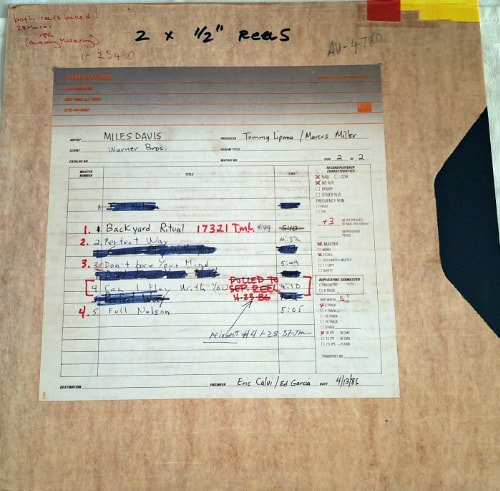
The Tutu master tape box showing Prince’s track ‘Can I Play With U?’ before it was pulled from the album. It was originally going to be edited and placed at track four.
A reproduction of the Tutu master tape box is included in a Rhino Records special LP release of the album. The handwritten notes were by the assistant engineer Eddie Garcia?
Yes. He was more the constant [in the recording process]. At the time in the 80s, being a mixer was different from being an engineer. You were like a mini star; you were right under the producer in terms of the hierarchy.
The writing on the box reveals that Side Two of the Tutu LP would have included the track Prince had written for Miles, ‘Can I Play With U?’ Its original length was around 6:35 in terms of track time, but the version slated for Tutu was 4:10. Do you know who edited the track?
It could have been anybody. They’re easy edits, so it could have been Eddie with Tommy or Eddie with Marcus. I don’t remember if I did it on the spot. You may have a song that is a certain length and then you bring the fader in a bit earlier to make the whole thing a little shorter. I wish I could give you more technical stuff on that aspect. I don’t recall much editing as we were mixing. It’s not like they were changing their mind and moving things.
Do you think it was the right thing to pull Prince’s from Tutu?
Yeah, definitely. I don’t think it should have been on the album, so I think it’s a good, logical move, not to include it. But the track was great. Now, what’s out there [it was officially released in the 2020 release of Sign ‘O’ Times Deluxe boxed set] it seems like it’s been sweetened and stuff was added from what I worked on. It doesn’t have the vibe of that. It became too Prince-ish. So what I heard was actually a bit rarer and more experimental. I felt super privileged, just like when I got to work with Miles for the first time [on the Decoy album] or working with George Benson, hanging at this place and jamming with him.
It’s a meeting of two giants and because it’s a conversation. Look at the title: it’s about playing together, in the original term sense, not musically, but literally playing. And I would say that’s the track, which to me was the most special. That’s where I was thinking of Trevor Horn or how this could have been more modern, or should have been a hip-hop album, because that’s what was happening there. When I remixed that, it was totally different. I always think of Miles and Prince as Matisse and Picasso.
I would say probably Matisse is Miles and Picasso is Prince, because Prince peaked early and Miles peaked late. He really started peaking with Kind of Blue then later there are the electronics and all that stuff. While Prince basically started peaking with his third album, then it kind of went down. Picasso did that and Matisse did that. Matisse peaked with his last work.
They were really playing together, in a conversation. It made me feel humbled and not wanting to intrude on that track. It’s a humorous track – can I play with you?
There’s some humour on Tutu – “One mo’ time” [the Count Basie voice sample on ‘Perfect Way’], Marcus plays the bass clarinet, which has a humorous quality to the sound. He also plays the soprano sax, which is a funny instrument, because the tenor sax is like the business side of the sax. You could tell by the way Miles and Prince were interacting that there was also affection; something that’s also common to Matisse and Picasso. To go back to the question, it doesn’t belong with Tutu, because you have this direct conversation with the other musician.
You mixed four of the album’s eight tracks (‘Tomaas,’ ‘Perfect Way,’ ‘Don’t Lose Your Mind’ and ‘Full Nelson.’ Bill Schnee had mixed ‘Tutu,’ ‘Portia’ and ‘Splatch,’ and Erik Zobler mixed George Duke’s ‘Backyard Ritual.’ Did you use their mixes as a reference for yours?
I was certainly not interested in Bill Schnee’s, which represented the antiquity of the LA sound, which in the 80s New York, was the worst possible sound. I mean Yacht Rock and things like that. You see, in the 70s I loved the LA sound; in the 80s it became the enemy. I was more attuned to the English sound and producers like Steve Lillywhite who worked with U2. Also, the productions of Depeche Mode, Soft Cell, and the Prelude label, with bands like D-Train. I loved Cameo and worked with them on Word Up! It was bass line-driven stuff and so much fun.
What’s interesting is that in the 80s, you had all those records where you’d have six producers, six different mixers, and none of the tracks matched. But they were rolling the dice and hoping that maybe, one of them would win. So it was kind of like an 80s thing where Warner weren’t too concerned with the album [having different mixing engineers]. I think today, you would want one person to mix the whole album so there’s a continuity of sound. There is a difference between the mixes [on Tutu], but it’s not big enough that it made a huge difference for the listeners, because there’s a consistency with the production.
Can you describe the process of mixing the tracks?
I knew all the tracks, so there wasn’t much of a surprise. It was more about putting a gloss on things, balancing everything, making it sound better.
Were they 24-track mixing sessions?
By that time, very few people at that level were doing 24-track, as 48-track was easy to do at that point. You had digital machines from Sony, 3M and Mitsubishi – we did Word Up on the 32 track Mitsubishi. I guess we used 48-track.
Can you talk me through, how you went about mixing also? Were Marcus or Tommy involved? I suspect Miles probably wasn’t.
Miles was not. I don’t think he was interested in it. In fact, even when he was running the band and recording Decoy, he would rarely come in the control room, even to listen to the playback. It’s not as stupid as it looks. It’s actually a clever thing because what the music is doing is really capturing performances. So it’s better to be at home and put on the reel-to-reel and listen to what has been done these last few days.
Marcus was more involved, but also they would leave me alone for most of the time So, if I started at 11 a.m., they [Miller and LiPuma] would show up by five or something. And we took some time: most of those mixes took two days to do. When I worked with Thomas Dolby, I mixed an album for Prefab Sprout called Jordan [released in 1990]. We mixed it in LA, and were mixing three or four days per track.
So you set up one day, you mix, you come back, you listen to it, you do some tweaking, and you mix and mix and mix, and then that’s it. And then you set up for the next one.
Was any of the mixing challenging, for example, mixing the trumpet sound with the electronic sounds?
Not that I was aware of. They liked it, they approved it; they were happy. There was no “we’ve mixed it. Let’s try that again”, or even worse: “let’s give it to someone else.” That’s because we had built the track to sound pretty much the way the mix ended up. I’ll say in hindsight though, I prefer Bill Schnee’s, because as I’m getting older, and I’m back to listening to 70s music from LA, that’s kind of closer to that. You know, it breathes more; it’s mellower, it’s less nervous. Mine are more nervous, but that’s why I was probably hired to do this record.
For that New York energy.
Yeah, that’s it. I don’t know why some of it was done in LA. Why wasn’t the record all recorded in New York? I don’t know.
Originally, Marcus flew out to LA with his three demos. They were going to use them and George Duke’s and maybe Prince and somebody else. It wasn’t until they heard Marcus’s tracks that Tommy and Miles decided to get Marcus to do the rest of the album. Marcus was based in New York and the music industry was moving from LA to New York, so it made sense to record it there.
So they started in LA because was Miles there as well?
Miles lived in New York and Malibu and spent a lot of time in California. And of course, Tommy La Puma was there and Warner Bros. were there.
I think that my tracks sound more 80s because I was a child of the 80s. I was listening to Art of Noise. I was listening to a lot of British productions, like Phil Collins. I was listening to all the electronic stuff. I was bringing that Tommy Boy Records sound to those mixes: lots of gated reverb, lots of closed space, lots of separation, less of an organic sound, and more of a fractured, and even though we weren’t doing cocaine, cocaine induced. I was not doing any of that stuff because when you’re an engineer, if you stop functioning, then everything stops. You can’t be that type of guy.
Do you have a favourite mix of the four? I suspect it might be ‘Don’t Lose Your Mind.’
Yeah, that’s the one. ‘Perfect Way’ is not because I always compare it to the original and so therefore it’s never good enough. To this day I listen to those Scritti Politti albums.
Jason Miles tells me you also remixed ‘Full Nelson’ [Eric says he cannot remember this, but then listens to the remix]
That sounds like something I may have done. I like it!
Is Tutu an important record?
It was an important record in the world of jazz at the time. But what rubbed me up a bit the wrong way, was that it was behind the curve in terms of popular music. So it’s like jazz catching up to what happened in 1983. For example, the album starts with an orchestra hit, and Art of Noise had done that years before. I don’t think that Marcus was listening to [producer] Trevor Horn, but who knows?
But on the other hand, ‘Perfect Way’ is great – that was really modern. Miles was still leading the show by picking that song, and wanting to name the album after that song [the original name for Miles’ new album was set to be Perfect Way, but Tommy LiPuma thought Tutu was a stronger title]. What was interesting about ‘Perfect Way’ was they had started using some amazing stereo samples. Up until then, it was all mono.
On ‘Perfect Way,’ they were also creative in their melodies and arrangement. In the tune is a bridge that is in 5/4 – whoever heard of a 5/4 bar in pop music? It’s normally in 4/4. I remember when we all listened to it, we said: “Did you hear that 5/4?!” So Miles picked up on that, so you could see that he had in his mind to do something very 1986.
What’s your verdict of Tutu?
I was going to say it’s the most advanced, the most formed, most imaginative jazz album of the 80s, but really there’s nothing that comes close to it. It’s in its own category. The only person who has come close to it is Jason Miles with his one track [the title track to his 2026 album 100 Miles]. Tutu is a major album, way more than You’re Under Arrest.
Many thanks to Eric for even more of his time, and for providing the portrait shot.