Interview dates: 25 April and 25 May 2023 (Minor updates and revisions April 2026)
Gene Perla is a remarkable polymath – he’s a bassist who has also been a composer; music publisher and recording engineer. He co-founded a recording studio and set-up and ran his own record label. He’s also been an agent, manager, educator, and more.
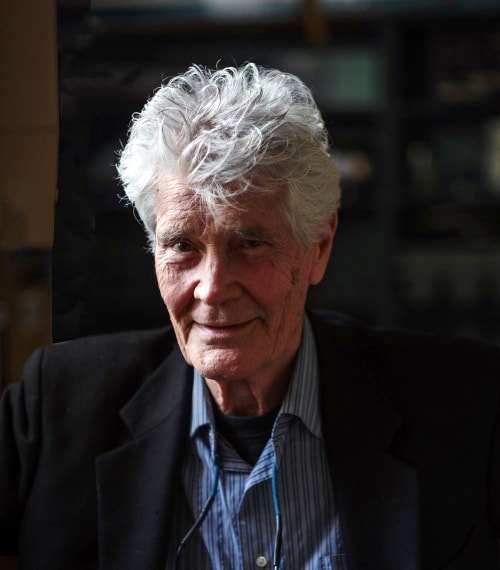
Gene Perla by Jon Broady.
His impressive musical career includes recording with Miles Davis; backing Frank Sinatra, and joining the bands of Nina Simone, Sarah Vaughan and Elvin Jones. He co-founded the jazz/funk/Afro-Cuban/rock jazz trio Stone Alliance with Steve Grossman and Don Alias. Gene started out learning classical piano, later adding the trombone to his musical arsenal. But when he was twenty-four, he heard Charlie Haden playing bass on Ornette Coleman’s classic 1959 album, The Shape of Jazz to Come and that inspired him to become a bassist.
In this interview, Gene talks about his extraordinary musical career, including two memorable occasions when, being in the right place at the right time with his bass guitar, he ended up on a recording session with Miles Davis, and playing with the Elvin Jones trio on a live TV broadcast.
The Last Miles: Your career encompasses the creative, technical and business sides of the music industry. Do you think many musicians realise the importance of the business side, and how vital it is to have a multiple portfolio of skills?
Gene Perla: Let me jump right to Winton Marsalis. When he entered the scene, he astounded many people – including me – with his trumpet playing capability. He’s a guy who has won Grammys for both classical and jazz, and there are very few people in the world who have that capability. And his explosive entrance onto the scene influenced many musicians, and in particular black musicians, who were up and coming. They looked to him as a guide; a beacon going forward. He was into the business: you dress up nicely, you take care of this, and you do that. He had a tremendous influence.
What you were describing are musicians who didn’t pay attention to business, who knew very little and understood even less. I have been teaching music business classes for decades and it’s interesting that the classes I now have ask more questions about the business side than previous classes I’ve had.
Important revenue streams for any musician are compositions and music publishing. I wonder about the nature of jazz, where there’s often a lot of collaboration, improvisation and exploration before an actual tune is developed. Where does composition start and collaboration end? Miles Davis would come up with a sketch and then the rest of the band would contribute. Some musicians I’ve spoken to thought that maybe they should have had a compositional credit for some of these pieces. Is it difficult – particularly with jazz – to know the line between collaboration and composition?
I want to first give you a scenario and then I will answer your question. When John McLaughlin decided to form Mahavishnu Orchestra, he called Miroslav Vitouš to be the bassist. And Miroslav told him, “No, I’m with Weather Report.” So, he called me and the very first rehearsal was John, drummer Billy Cobham, and me. When the rehearsal was over, John said, “It’s your gig if you want it,” and I replied, “I’d like to do another rehearsal, and by the way I hear you’re looking for a keyboard player. My roommate Jan Hammer could fit very nicely. Instead of spending the money on a rehearsal studio, please come to my loft next time.” The next time Jan was there. Billy couldn’t make it, so Don Alias played drums. At the end of the rehearsal, John asked, “Are you going to do the gig?” I turned him down, because I was with Elvin Jones. I wish I could have done both gigs. Jan got the job.
When we got together for that rehearsal, John had some sketches, but I made up bass lines and Billy made up rhythms. When I tell my students this story, I ask: “Was I just a sideman or was I a writer of the music?” Bass lines can have a tremendous influence on songs. Would I have gotten credit? That’s why the Mahavishnu Orchestra split up, because John did not acquiesce to some of the group members’ desire to receive a percentage.
What I attempt to do when producing – whether I’m playing or not – is when someone says, “Okay, that’s the take,” I ask them to determine who wrote what. We work the deal out by attributing agreed-to percentages. It’s better to establish this business sooner than when suddenly, the band explodes and there’s zillions of dollars coming in and egos take off.
I’d like to talk about three singers you played with: Nina Simone, Sarah Vaughan and Frank Sinatra. Let’s start with Nina Simone. She’s fascinating on so many levels – as a pianist, as a singer and as a personality. What are your biggest memories of her, and what it was like to play with her? I just imagine it being quite nerve-racking, because she had a reputation for being a perfectionist. I think you played with her from 1968 to 1970, is that right?
Something like that. I came to New York in 1967 and started a calendar in 1968, so I know pretty much every gig that I played. I was playing a Sunday afternoon gig in the New York City East Village, and on a break, I came off the bandstand and this burly black man came up to me and said, “My name is Andy Stroud and I’m representing Nina Simone.”
I don’t know if someone mentioned my name and found out where I was playing, or if they had just walked in off the street. He said they were looking for a bass player: would I be interested? I said, “Sure.” We did a rehearsal and got hired. I’ve said this many times that Nina’s power rivalled anyone else. The breadth of her delivery was from a floating feather to a volcanic eruption. That woman could go from one to another – just like that.
Presumably when you were on the bandstand with her you really had to be on your toes really, ready for anything?
I took classical piano lessons for ten years, so I knew this music. Because of her power in that genre, I was able to fit in with her, just like a hand in a glove. It was even rhythms rather than swing. We didn’t swing with Nina. It was more ballads and pushing towards rock-‘n-roll.
And what was she like as a person off the bandstand? Did you socialise with her at all?
A little bit. We travelled together by car or flying. I visited her home a few times on a social level but wouldn’t characterise it as hanging out.
I’ve only heard her music and seen videos of her, but Nina Simone did seem like a deep person who was quite impenetrable in terms of getting beneath the surface of her. I don’t know whether that’s the case or not.
No, I wouldn’t describe it like that, at least not from the way I think about her. I feel that her heart was right there in front of your face. But she didn’t want to take any shit from anybody. And she was really pissed off about the racial thing – really angry about that. She had this tough veneer; she had her armour. But at the same time, I always felt from her that she was speaking right from her heart.
So, you were with Nina for about two years. Did you go straight from her to Sarah Vaughan? In 1970, you spent a whole year with Sarah Vaughan, from January to December. What was it like working with Sarah Vaughan?
In the beginning, that girl made me nervous!
Why was that?
Because she was so laid back and a party girl! Talk about hanging out and socialising – that was night and day between her and Nina! Because I knew of her past, and what she had accomplished, and of course, listening to her sing prior to getting the gig, I was thinking, “This is the top end. Who’s left after that: Ella Fitzgerald?” And it wasn’t so comfortable because the band had been put together by her previous bassist who hired two Las Vegas fellows who weren’t at the right level.
I got close to Sarah quickly in terms of socialising. In fact, the very first night that I met her, we played a gig in Puerto Rico, and after the gig, she seemed to want to hang out and I said: “Right across the street from the hotel I know this trumpet player who used to be at a club in New York City, and then he moved back to Puerto Rico.” We went across the street and sat at the bar, and that’s how we started our social friendship.
A little while later I said to her “I’ve met this piano player,” and she said, “Get him.” That was Jan Hammer. And for a drummer, I asked her, “Should we try Jimmy Cobb?” She said, “Go ahead.” I called Jimmy, who didn’t know me, but he joined the band. That trio took off. It was like liquid.
And Frank Sinatra?
I only played with Sinatra once, but I’ll tell anybody that he’s on my resume! It was my early days in New York, around 67, or 68. There was a saxophonist in Brooklyn named Pat Rizzo who had a big band. He asked me to play and as time went on, he called me saying, “I’m moving to Los Angeles, if you ever come out here, you can crash with me.”
Some years went by and our initial Stone Alliance group had broken up, and I was so despondent that I called my best friend for over forty years, percussionist Don Alias, who was living in the LA area. I asked if I could come out and hang with him to which he agreed. So, I drove out to LA. One of the first things that I did was call Pat Rizzo and said, “I’m in town.” Half an hour later he called back and asked, “What are you doing New Year’s Eve?” I responded, “Nothing, I just got in town today.” And he then asked, “You want to play at Frank Sinatra’s house?”
I’m Italian and grew up in New Jersey and Frank was from New Jersey. I called my mom saying, “Mom, are you sitting down? Guess where I’m going on New Year’s Eve? I’m going to Frank Sinatra’s house.” There was a long pause, then a scream followed by a command: “Tell him to give you some money!”
Pat had hooked up with Sinatra after arriving in LA and was his musical director for private functions only. Pat told me that in all the private functions he had put together. Frank never sang. But he did that night: four tunes. One of them was ‘On The Sunny Side Of The Street.’ I think he sang because of my beat which spurred him on, and when listening to this song he sings through part of the first chorus and then drops down singing a bass line.
When you started out as a musician, your ambition was to play with Miles Davis and with Elvin Jones, and you achieved both. What was it about them that made you think: “I really want to play with these guys?”
Well, Miles is a very simple one, and I will say this to anybody and debate it with anybody, that he’s the greatest jazz musician ever, not so much as a player – although he’s fantastic – but as a band leader, as a conceptual leader of music. The way he put people together; his business sense.
That group with pianist Wynton Kelly and bassist Paul Chambers – the First Great Quintet and then his next group with drummer Tony Williams – the Second Great Quintet. Other guys have made fabulous music, but I can’t think of anybody who’s achieved the depth of what Miles has done. In the late 60s, he’s flying, and of course, he’s the guy I want to play with. But I never ever thought that I would get that chance – it just fell out of the sky.
Elvin played a bass drum fill on Wayne Shorter’s Speak No Evil album and I remember listening to it as a student at Berklee School of Music. When I heard him play that fill, I said: “I have to play with this guy.” His swing: his feel was just to die for.
I was amazed to discover that you were present at Miles’s Bitches Brew sessions, and when they were recording ‘Miles Runs The Voodoo Down.’ Don Alias famously switched from percussion to drums on that track, and played a beat that Miles felt was right for the song. And I believe you had taught Don that beat! Can you take us back to being in the control room: what did you see through the glass, and please go through the story of the difficulty that Lenny White and Jack DeJohnette were having in getting the beat Miles was looking for?
I don’t really know what Miles was trying to achieve. The thing was, it wasn’t working for him, and they tried it, two or three times. At one point, Alias said, “Miles, I got this beat and it might work for this.” Miles said, “Go to the drums.” He started playing, and one thing led to another, and that’s it. I had gotten this drum pattern from a fellow named Chris Hills, a bass and guitar player. I learned how to play it on drums and showed it to Don.
It was notoriously hard to get into a Miles Davis session. How did you manage it, and did you have any interaction with Miles, his producer Teo Macero or engineer Stanley Tonkel?
I was able to get into the studio because I walked in with Don. No interaction for that session, I may have said, “Hello,” but I never entered the recording room. I was just in the control room. One thing I do remember was that I was standing and Miles looked into the control room and he didn’t like it. He asked who I was, and Alias explained that I was his friend. Miles said to him, “Tell him to sit down” which I did.
And there’s the famous 19 May 1970 session, which was Keith Jarrett’s first studio session with Miles. Also in the band were John McLaughlin, Herbie Hancock, Steve Grossman, Billy Cobham and Airto Moreira. The band are recording two numbers, ‘Honky Tonk’ and ‘Ali,’ and the story goes that Miles’s regular bassist Michael Henderson disappears for an hour…
He showed up about two hours late.
How did you get to play bass on ‘Ali?’
That morning Don said, “I’m going to record with Miles. You want to come along?” I had a gig later that night and had my electric bass with me, talk about luck! Miles was waiting about an hour and a half and over the studio monitors I heard Alias say, “Miles, there’s a bass player in the control room,” to which Miles said, “Tell him to get his ass in here.” I immediately started shaking with fear, as I didn’t know anything about the music and I’m in the room with these top people.
I went to the amplifier, plugged in and quickly got an acceptable sound. Miles then sang the bass line to me and that was it. That was the whole tune. I’m good with picking things up quickly and as he walked away, he said, “Don’t make it swing.” If you listen to that track, it’s quite ricky-ticky, [mechanical and repetitive]!
It must have been quite thrilling for you when your recording date with Miles appeared on the Jack Johnson boxed set released 33 years later.
Yes, but even more than that: you know about the Miles Davis Wall?
That’s the wall with the names of all the musicians who played with Miles. I saw it in Paris at the We Want Miles exhibition.
Well, I’m on it, all the way at the bottom in the smallest typeface, underneath Dave Holland. How bad can it get?
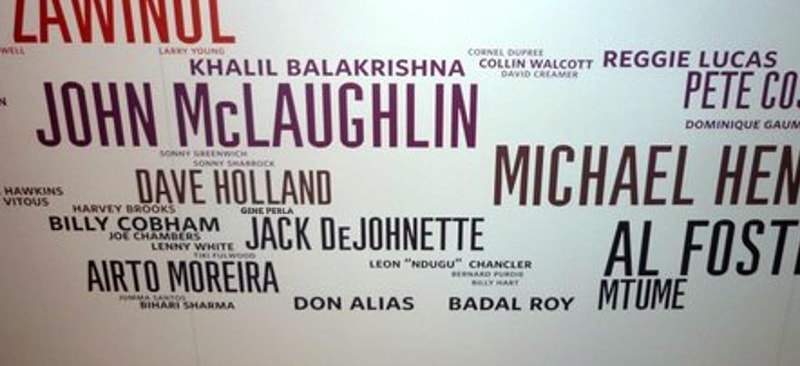
Gene Perla on the Miles Wall of Fame. Gene’s name is under Dave Holland.
What were your thoughts about Miles’ music in the 70s, and indeed in the 80s?
I didn’t like it quite frankly; it was too free. To me, swinging those quarter notes is the reason I became a jazz musician. That’s what swing is and what turned me on to jazz music. To be an integral part of the swing, the foundation of the swing; that’s me. I appreciate what people have done, and some of the stuff sounded great, especially some of the recordings. In A Silent Way was like the first crack in the door of going towards something else.
There’s a TV show with David Sanborn and Miles playing together, and Alias is playing and it’s fabulous. But there was a lot of that screaming stuff in the 70s music. Saxophonist Dave Liebman was one of my oldest connections – I met him when I first moved to New York and got him the gig with Elvin. Then we formed the Lighthouse band Elvin Jones, Steve Grossman, Dave Liebman and me. Even Liebman said: “It’s a lot of noise.”
And what about the music he made in the 80s, in the last 10 years of his life? Starting off with Mike Stern and ending up with merging jazz with hip hop?
I’ve heard so little of it. I would have to listen to give you an answer. I think Marcus Miller was very important in bringing beauty back into Miles’ music.
Were those two sessions the only sort of times that you were in the same room as Miles? Did you have any further interactions with him?
When Mahavishnu first got together, one of the first shows they did was in New York, and I went to the show. Miles was standing at the back leaning against a railing, and I walked up beside him and I said, “Hi, Miles.”
I don’t know if there were really any words. That was just a hello. But there was one other time that I was producing a band in Montreal who played instruments and sang called The Bug Alley Band. They put words to ‘Milestones.’ I knew enough about business by then to tell them they needed permission. Playing a song live might not cause trouble, but on a recording involving money, that’s another story.
I collected Miles’ phone number and called. Miles’s drummer Al Foster, who was hanging with him those days, answered the phone. I told Al that I’d like to speak with Miles about a business thing. I heard him explain this to Miles who then came to the phone. The first thing he said is, “Why are you bothering me?” He would push people to see how they’d react. That stuff has never bothered me, so I said, “Hi Miles, how are you doing? I’m producing this band, blah, blah… and I want to know who to contact to try to get permission?” He right away gave me the number of a lawyer in Connecticut and boom! That was it. Like his music, he always gave you just enough of what you needed to know and that was it. Maybe if I had been in his band, I might have hung out at his home socially.
The story of how you got to play bass with Elvin Jones for the first time is amazing.
I was playing a week-long gig in Boston. On one of those days, with a couple of friends, we went to the Berklee School of Music. While hanging in the lobby area, a phone call came in from a local TV broadcaster. The receptionist called out to us saying, “It’s WGBH TV. Elvin Jones needs a bass player right now.” Man, I ran out to my car. Fortunately, I had my electric bass. I didn’t care about cops, and there were none. I got to the station not many minutes before the live show started.
What did I know about the music? It was saxophonist Joe Farrell, Elvin, and me. Talk about bare bones. No hiding place. We played a few tunes which got recorded. I have an audio copy of it – I should have asked for the video. Listening back, you hear here and there that I got off playing wrong notes relative to what Joe was playing.
I had heard a few days later that Elvin was talking to somebody, and according to what this person said, Elvin said that he was playing with this white guy who made the electric bass sound like an upright, and that’s always been my thing. I want that warm round sound. A few months later he called. You know that saying that American farmers say? When they’re out in the field and happen to step in cow flop, it’s meant to be a sign of good luck. So, I stepped in shit on that one. Absolutely.
Can I ask you a little bit about Joe Farrell? Because he’s one of those people who seems to have got lost in the history of jazz. What was he like, both as a musician and as a person?
I think he was a tremendous musician from the point of view of his capabilities to be a complete studio musician. He played from piccolo all through to the bass flute. He played many saxophones from sopranino all the way down to baritone. He played the double-reed instruments, and he owned them all. In those late 60s and 70s he was going from one recording session to the next, doing commercials and more.
I asked him: “How’s the studio business going?” He said: “I made a quarter of a million dollars last year.” That’s not bad for a side musician back in those days. And he played jazz. He could swing; he did a bunch of music together with Chick Corea. But the swing was not Sonny Rollins’s or John Coltrane’s or Wayne Shorter’s or Stan Getz’s. It was not as greasy. That’s what bassist Christian McBride has said: “There’s not enough grease these days.”
With Elvin, Joe never seemed to settle down. I don’t know if he was trying to out manoeuvre Coltrane in terms of pyrotechnics on the instrument, because he could play fast. But most of the time it felt like Elvin, and I were laying down this carpet, and he was skating across the top of it. But when Frank Foster came in, at least then we were hitting up against something. So, Joe was kind of withdrawn; it always felt like he was preoccupied with something else. I never sat down with him and had a heart to heart about anything. But we were friendly enough.
Can you tell me what Elvin Jones was like both as a person and a band leader? Presumably, he had lots of stories about John Coltrane?
Okay, so as a person, some years ago in my town where I live in Easton, Pennsylvania is an institution called Lafayette College. The duo of Chick Corea and Gary Burton gave a concert there. I knew they were going to do a sound check, and I hooked up with Chick and we talked a bit. Elvin’s name came up in the conversation and Chick said something to the effect that he was the sweetest guy of all time.
And he was – and so giving, magnanimous. And my belief is that he knew who he was. He knew that he had power. He knew that he was special. But it did not get into his ego at all. He was giving, sweet, and friendly to everyone. Better not fuck with him though. Elvin quote: “You better be able to play good if you get up on the bandstand.”
I love this story: The quartet with Grossman, Liebman, Elvin, and I were playing at the Left Bank Jazz Society in Baltimore. On the first break, Grossman – who was timid with Elvin – came to me and said, “I know this piano player D.C. and he would like to sit in. Would you ask Elvin if he could?” I’m thinking to myself: “Why in the fuck don’t you ask him?” but I said OK and asked Elvin. Elvin said “Yeah – tell him to come up on the last tune of the set.”
When the set was over, I asked Elvin, “What did you think of the piano player?” And Elvin said, “He ain’t got no ass.” I’ll never forget that as being one of the greatest descriptions. In just a few words, he said the guy had no swing. I spent a lot of time with him socially in his home and at dinners, and it was just wonderful.
As a bandleader, he’d make the sets and call the tempos, and we’d play. There was never a discussion about “Play this or play that.” The only thing he ever said to me a few times was “Turn it up,” because I come from the ‘no amplifier’ days of playing. I never heard him speak to any of the other band members – we’d just get to the gig and play the music.
Now, about Coltrane. You know how many times I have been asked this through the years since I played with Elvin? I didn’t want to discuss Coltrane with him – never, and it only happened once. We were at the Village Vanguard bar having a drink and during the conversation, Coltrane came up. I asked a question – I don’t recall what it was – but his answer was another tremendous lesson for me. “I don’t know Gates [my nickname]. It was just a series of circumstances.”
He was talking about his time with Coltrane and I knew exactly what he meant. It meant that you wake up in the morning; you go through the day; you do what you do. It’s a sequence of life. That’s it. They got on the bandstand, they played. Nobody was thinking, “We’re going to change the world.” They wanted to play the best music that they could. So, they did it. Others told us about what the results were.
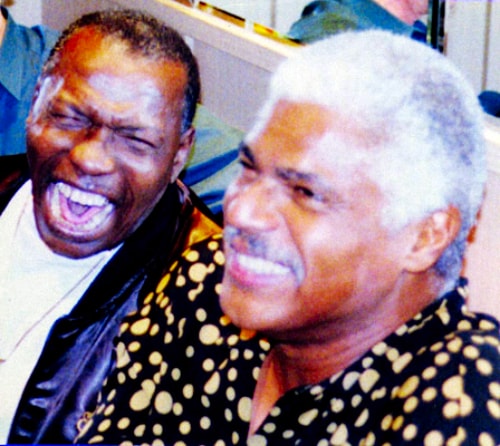
Elvin Jones & Don Alias by Gene Perla.
The 1972 album Live at the Lighthouse album has a very interesting line-up: two saxophonists and no keyboard player.
When I joined Elvin there were two saxophones, Joe Farrell and Frank Foster. Upon my recommendation, Liebman joined, making it three saxophonists. Then Joe split. I then got Steve Grossman in and then Frank left. I convinced Elvin that we should get these fellows because they were on point. Later, when Liebman left, Azar Lawrence joined. It was always two horns and then a little bit later, guitarists started showing up, then keyboard players. I also got Don Alias in the band.
People would come to the club and listen to Elvin and Don Alias and be scratching their heads. How is this possible that this conga drummer can fit with what Jones was doing? And he could – it was tremendous. I also got my roommate Jan Hammer to come and play and do some recordings.
One time on a gig in Boston, it was a quintet with Don, Elvin, Steve, Dave, and me. It was a particularly burning set that evening, and when we got back to the hotel, Don and I called Jan Hammer begging him: “You have to come; you have to join this band,” but chose not to – he wanted to be a rock and roll star. The person who had a big influence on piano-less music was Sonny Rollins. He did that thing at the Vanguard [A Night At The Village Vanguard, released in 1957] with Elvin and bassist Wilbur Ware.
We’re going to talk about Steve Grossman in more detail later, but basically that Lighthouse album catapulted Grossman in terms of recognition as a phenomenal jazz saxophonist even more than his association with Miles Davis. It was such an incredible performance. Do you agree?
Absolutely. Even Liebman has said many times that it was because of Elvin that he became well-known. Elvin did a radio interview and I went along with him. The DJ asked Elvin about Steve and Elvin’s words were to the effect that after John Coltrane came Steve Grossman. He knew that Steve got in the centre of swing, just like Coltrane.
Miles poached Dave Liebman for his band, and as you say, you got Azar Lawrence in as a replacement.
It was kind of sad that it happened. Azar could swing, but he didn’t know his scales and chords that well.
I just want to talk briefly about some of the gigs you didn’t take up. You’ve already mentioned how you turned down John McLaughlin and Mahavishnu Orchestra, but I believe also that you turned down a gig with Bill Evans, and there was talk of Hendrix possibly playing with you at some stage. So, tell me about the ones that got away.
The Bill Evans story makes me sad. It broke my heart. He called me on the phone one day in 1978 and Philly Joe Jones was playing with him. He said, “I’m looking for a bass player. You want to come to my home and play some?” I became a jazz musician because I wanted to be a Bill Evans on the piano. It was like an amazing circle was closed.
I went to Bill’s home in New Jersey and rehearsed with him and he said, “Okay you got the gig. We’re going to Los Angeles for a week, then we’re going to play the Village Vanguard [a live album, Getting Sentimental was released from this gig] and then we’re going to Greece.” I was so excited. He asked me to call his manager, Helen Keane, to work out the details. As soon as I got home, I called her, and I said, “I’m Bill’s new bass player,” and she said, “No you’re not. We want to try somebody else.”
It turned out that she wanted to try Michael Moore. Later, Bill called me and he said, “This is what we’re going to do: you come to Los Angeles, and Michael will play the Vanguard, and then we’ll decide.” But I turned it down because I felt dissed. Maybe I should have gone – I don’t know. The thing that irks me a little bit is Michael Moore is a marvellous musician. He really plays well, but there is something he doesn’t have, and I do.
Thinking of Bill Evans’ classical, ethereal, Debussy approach to jazz, and Philly Joe! Talk about bang those beats man and cook! I could have been the guy who would fit right into that. I would have cemented those two sides; at least that’s my feeling.
Sometimes, I think I should have done that gig, because I probably would have got the gig, but it also pissed me off that they offered me Los Angeles, out of town, and giving Michael New York. Why didn’t they give me New York? I probably would have said yes, but anyway that’s the Bill Evans story.
And you might have had a chance to play with Jimi Hendrix?
In the earlier days, we had a group with flautist Jeremy Steig, Don Alias, and Jan Hammer. We did some festivals and one of them was opening for Hendrix. I never met him and I don’t know if he heard me play.
Jeremy got a contract with Capitol Records and he decided to use Jimi’s studio, Electric Ladyland [in New York]. We had our shit together, walked in, and in three hours knocked out the album. Two days later, Jeremy and I went to the studio. Our engineer was Eddie Kramer, who was Jimi’s engineer. He handed us the cassettes of some rough mixes and as he handed them to us he said, “By the way, when I was doing this mix yesterday, Jimi came in and was listening for a while. He asked me who the band was, so I told him, and Jimi said, “I’m going to England, and when I come back, I want to play with them.”” And he never came back [Hendrix died in London 18 September 1970].
That collaboration would have been something else. With Jan Hammer’s electronics and Mini-Moog, and Don Alias with drums and conga drums, it would have been absolutely phenomenal. I have no doubt that that band would have gone boom!
I’d like to talk about your move to electric bass: when it happened, why it happened, and who or what influenced you?
Wow, I’ve never been asked that question. Well, you know, because of listening to Charlie Haden, I decided to become a double bassist. I realised that there was this other bass instrument that looked like a guitar. I felt that if I wanted to be a more rounded musician, then I should be able to play this because of the various styles of music. That probably was the strongest reason why I got one.
Shortly after the double bass became my primary instrument, I landed a job playing in a Latin dance band. By studying and listening to Latin music, I became aware of the Ampeg Baby Bass that Latin bassists were using. I never got one of those, but I played the big bass with that Latin dance band.
I’m not even sure when I got an electric bass, whether I was still in Boston or I’d moved to New York already, but when I moved to New York, some gigs started to happen because of that movement at that time of jazz going into rock. The people that I was involved with were thinking more funk, and R&B. And so that’s what happened.
I’ve heard in an interview you were asked your two biggest influences on bass and you mentioned Charlie Haden and Jaco Pastorius.
I’d been playing bass for years before Jaco came along. I think the only jazz player I was aware of who was playing electric bass was Monk Montgomery, Wes’s brother. I think I may have heard a record with Monk playing on it, and I wasn’t impressed. Compare that to how many of us were impressed when Jaco came on the scene!
Don Alias was working with Blood, Sweat and Tears, and they were in Florida. Somebody said, “You’ve got to check out this bass player down here,” so they went to a club and heard Jaco play. Everybody, of course, was knocked out. Don, from time to time, would call to alert me to anything he felt was significant. Because I had a record label, he thought there might be a new, young artist who could help my company.
He called me about Jan Hammer which led to me getting Jan on the gig with Sarah Vaughan. Don called me from Florida saying, “There’s this bass player down here, man, you’ve got to check him out.” I said, ‘Give him my phone number.” A couple of weeks later, I’m sitting in my office, and the phone rings. I picked it up and said, “Hello,” and Jaco said: “My name is Jaco Pastorius and I’m the greatest bass player in the world.” My reaction was, “whoa, what an ego!” But, as it turned out, he was on target.
The next thing that happened was that Jaco was recording his first album at record producer Bobby Colomby’s home studio and was doing the track with the French horn [‘Okonkole y Trompa’]. Don asked me to come along to the studio where I met Jaco for the first time. As far as being influenced by electric bass, Stanley Clarke was around and there were some other fellows whom I appreciated.
But when Jaco hit, man, I said, “This is really music,” because that guy was just complete for me. From my perspective, he was just absolutely the top. Perfect musician: music just oozing out of his soul, until he had his mental health issues. I will be astounded if there’s anybody who reaches the level that Jaco reached, because he was really something special.
Really interested in your thoughts on what’s called the Jazz-Rock era. What was your reaction when you first heard Miles’s Bitches Brew for the first time? And looking back on the jazz rock era, was it an exciting time, an innovative time, or was it a dead end for jazz?
To really answer your question properly I’d have to go and listen to it, because it was so long ago. I don’t think it hit me in any negative way, but more than anything, it solidified the idea that Miles Davis was an innovator as a leader; the way he morphed one group into the next and how his music developed through those years.
I don’t have any negative feelings about the development of Jazz-Rock. First, we’re human beings experimenting with stuff. We try different things. Some of it works, others don’t. As someone once said: “You throw enough shit against the wall, some of it will stick.” And I was involved in it. But Jazz-Rock finally got to a point where I didn’t like it. It just got too cacophonous for me. I think, absolutely, meaningful music came out of the people who went down this road. For me, Herbie Hancock was doing that funk stuff and the music was delicious to listen to.
I’d like to talk to you about the New York Loft scene. An amazing time. I understand that you, drummer Bob Moses and Dave Liebman had lofts where many people played and rehearsed. Can you tell me how the scene evolved and a little bit about what happened in your loft? I think your very first Loft session had Chick Corea, Joe Farrell and Don Alias?
There seems to be two descriptions: There’s the “Loft Scene” and there’s “Loft Jazz.” I don’t know that much about it, but a couple of differences were that “Loft Jazz” were mostly run by black musicians, who turned them into businesses. There were others, mostly occupied by white musicians, who used them as living quarters and places to jam at all hours of the day and night.
People say the “Loft Scene” because of the space where these gatherings occurred. They were large, open rectangular rooms with a secluded bathroom and minimal kitchen facilities.
Where were the lofts geographically? Were they in old, abandoned, derelict parts of New York?
Mostly in lower midtown Manhattan and the Villages, not abandoned but some on the downside. I had two of them. The first was on Bleecker Street, just off the Bowery. It was a very down neighbourhood at that time, meaning that, I’d come home from playing a gig at two in the morning, and there would be unfortunate individuals sleeping on my steps, because the steps provided shelter from the rain. So, I’d have to ask them to move so I could get into my place.
I had a summer sublet from a modern classical dancer, Daniel Nagrin. He went to Africa for four months and I saw an advertisement in the Village Voice that his place was for rent. I was living in New Jersey at the time and looking to move into The City.
I secured it for four months and it had a grand piano and I had a set of drums. The very first night I moved in, Chick Corea and Joe Farrell showed up, because Don Alias had called them. In the next building, Bob Moses had a place. I remember going over there for a jam session.
And then I heard about a building on the West Side, where Chick Corea, Dave Holland and Liebman had places. Jack DeJohnette had a place on the Lower East Side. After four months, I found another loft, owned by the city of New York. It was downtown north of the Fulton Fish Market, just a half a block off the East River. And I could park my car right in front of the place 24/7/365. The rent, including the heat, was $95 a month. Unbelievable! What happened to New York? Most musicians can’t afford to live there now. Maybe there are some places in Harlem where the rent might be doable, but there’s no way that musicians trying to create a jazz life could do it today.
I had that place for a couple of years and there were tons of jam sessions I recorded. I’ve got reels and reels of recordings. I did jam sessions and quite a few people came by: Jimmy Cobb, Bennie Maupin, Joe Farrell, Mike Brecker when he was eighteen years old, Randy Brecker, Liebman. Grossman was a fixture, along with Jan Hammer, who was my roommate.
And the other thing I might say in terms of the music itself, Liebman more or less focused on playing free, but at my place, we played time. Very often it was not a song. I would just find a root and play that for a while, then change the root. Or we’d sometimes morph into a bebop tune, but it was always the time. That’s what I wanted: to swing. That’s the whole reason I became a musician; I like the feeling of the swing
How were the various loft sessions set up? What time of day did they take place?
We started usually in the afternoon and if there was no gig that night it would go into the evening. Occasionally, we’d be playing late and there was a fellow upstairs who got pissed off. One time, he poured water on his floor, which leaked through to my place. He was right to complain, because starting to play at three in the morning is not fair. I learned my lessons – you played during social hours. Jan was there full time and very often, Don Alias or we’d either invite a drummer over or just play the two of us. Just play, play, play, play, play. That was my practice.
I’d like to talk about several of the people you jammed with, starting with Don Alias, whom I believe you first met in Boston around 1963?
I started playing the upright bass in ‘64 and got the “Los Muchachos” Latin dance band gig later that year that he was on. The previous bass player in the Muchachos, John Voigt, was my roommate, and the bandleader, Dick Meza, came over one day to see him and brought Don along. I said “Hello” and that was it. But then I met him properly when I joined that Latin band.
Don Alias was a remarkable musician.
There was no one like him. He was so wide in his concepts and capabilities that he’d fit with anything. People would say, “Don Alias is playing conga drums with Elvin Jones? You’ve got to be kidding!” Jones, the pyrotechnic; and Don fit like a hand-in-a-glove. People would say, “Unbelievable.”
Grossman and I used to laugh at Don, but in a loving way, when he decided to take up the drum set, because he’d fuck-up while getting his shit together. But he got it together. He had his own style of playing the drums coming from that conga head. Some of that filtered into his swing. There was definitely a Don Alias sound. That guy was a sweetheart and everything, but boy, watch out. He had a line and if you crossed that line, he was ready to go down that road.
An Elvin story: Don was playing conga drums with us at the Jazz Workshop in Boston. I don’t know if Elvin had to go to the bathroom or he wanted to get another drink, or he wanted to hit on some chick, but he said, “You guys play a ballad. Don – you play the brushes.” Don had only been playing drums a little bit and I don’t think he spent that much time on the brushes. He kept getting the brushes stuck in the edge of the rim of the snare drum. We played the ballad and Elvin came back on the stage, and these were his exact words – Alias loved to tell this story – Elvin said to him, “You’re a non-brush-playing motherfucker!” It was so sweet to be associated with those two cats.
Am I right that you first met Jan Hammer on a John Abercrombie session, and you found the two of you clicked?
Yes, it was at the apartment of Tom Marx, who was the son of Zeppo Marx of the Marx brothers. Don Alias called and said, “There’s this piano player, he’s in Boston.” I was playing with Sarah Vaughan at Paul’s Mall in Boston and attended a jam session with John Abercrombie and Jan was there. We played and almost immediately Jan and I went like this [grasps fingers together] harmonically – we just moved together. At multiple times, we both shouted as we simultaneously, at the same instant travelled together harmonically. The first chance I got, I pulled Sarah aside and said, “We should get this guy!”
So that’s what happened. I was living with my mom in New Jersey, and he stayed with us for a while. I bought him his first car – we have a very long history together. The Jeremy Steig gig happened after Sarah Vaughan.
And you got him to play with Elvin, and then there was the Mahavishnu Orchestra. You opened so many doors for him.
It’s crazy not to do that. When running into someone with such talent – someone who can provide such beauty to the world, wouldn’t anyone want to just say, “Come on, let’s go” and push them out?
I’ve listened to Jan’s album, Sketches in Jazz album. I love his synthesiser playing, but I wish he’d play more piano, because he’s a beautiful pianist.
From my understanding of the jazz scene in the 70s, two pianists: McCoy Tyner and Keith Jarrett were going forward with the piano. Herbie Hancock and Chick Corea with keyboards, and I think Jan Hammer could have been there, and maybe even greater, because of his involvement with electronics. McCoy didn’t get into it as well as Keith except to play electric piano with Miles Davis. [synthesiser developers] Tom Oberheim and Robert Moog came to Jan’s and my Red Gate Studio bringing prototypes for Jan to evaluate and give his opinions.
We have talked about Steve Grossman, but I’d like to explore a little more about him and the albums you recorded with him, including your band, Stone Alliance. Steve famously joined Miles Davis’s band when he was just eighteen. I wonder whether you think this recognition and success at such an early age was more of a curse than a blessing. It might help explain what happened later with his drug addiction and the unfortunate demise of the first Stone Alliance?
Well, there’s no way that I can be objective about what caused him to get into the drugs – we all went in. Everybody I was hanging around with got into drugs. All of us tried heroin. I was on it for a short time, never the needle. There were very few of us who were absolutely clean. Everybody was at least smoking pot. I can’t really say that he just got taken over. Some of them just got caught in that. And I think that’s probably what happened with him. Perhaps because of the pressure, taking heroin makes it go away, which it does.
People had been telling me about him, and then he showed up at my loft. I may have met him in a club somewhere before to say hello. We played together many times. The core of the jams was Don, Steve, Jan and me. Sometimes, Liebman would show up, so we’d do some of the stuff with two saxophones. That core line-up probably set the stage for Stone Alliance, which came some years later.
I have mentioned that the thing that hits the nail directly on the head is what Elvin said in that radio interview: “After John Coltrane comes Steve Grossman.” For Elvin to say that; there’s no higher praise.
You have witnessed both a very young Michael Brecker and a very young Steve Grossman. Which of them made the biggest impact on you in terms of musicianship?
They both hit me as being tremendous musicians. The great thing about Michael was his technique; his clarity of the notes he’d spit out like a machine gun. So that was very impressive to me – how he had such a great command of the instrument. But in terms of influencing me or making the biggest impression, that’s Steve Grossman. How he placed his eighth notes – how they would swing. There would be times during a jam session where I’d lay out, and it would be just drums and tenor playing for a while, and then it could be just drums and bass playing. And sometimes, Don and I would stop and Grossman would keep playing. And it was just swinging so hard, man. It was like the greatest rhythm section that wasn’t there, was there. Yeah, amazing.
And how did you approach producing this first album, Some Shapes to Come [released in 1974]?
I was working at Todd Rundgren’s Secret Sound Studio which gave me access to do my projects. We all took LSD and recorded for a few hours, and that’s it. That’s the whole story.
You’ll notice that there are three songs on that album that are attributed to all four of us, because we made them up on the spot. I don’t know if I’ve mentioned the importance that record had for some people. Don Alias was working with David Sanborn and bassist Christian McBride was in the band. Bassist Matthew Garrison showed up and they were talking about things. McBride asked Matthew: “You know the Bible, right?” Matthew immediately said, “Yeah, Some Shapes to Come.”
You’ve got two compositions on Steve’s Terra Firma [released in 1978], ‘Relentless Lady’ and ‘This Way Out.’ On ‘Relentless Lady’ I was intrigued to see that you play keyboards as well as bass, and Don Alias played guitar.
There’s a track on one of the records we made where both of us are playing guitar and singing, ‘Kimmy and Donnie.’ Don used to jam on bass with Chick Corea and Tony Williams!
How did the Stone Alliance trio of you, Don and Steve Grossman come about?
We played together so much and it sounded full, and I thought, “Wow, it might be nice to see if the three of us could gig as a trio?” I asked Don first and he said yes, and then I asked Steve. We met at Don’s mother’s Bronx apartment and were sitting around the kitchen table. As soon as it was confirmed, Don said, “Okay, this is the way it’s going to work. Steve: you’re going to play the saxophone. Gene, you’re going to take care of business, and I’m going to be the leader.” My first thought was: “What about me, man?” But you know what? I had already seen the way he comported himself; the positive vibe that that man gave off; his strength and resolve. “Yeah, go ahead, you be the leader.” And he was a great leader.
As the business guy, I had to get the gigs. In 1976, I landed us a gig in Buffalo, New York at a club called the Tralfamadore, and then another hit in Woodstock, NY called Joyous Lake. I was also in touch with the US Department of State.
Back in 1971, I was working with Elvin at the Vanguard. On a set break, I went to the bar, and this fellow came up to me and introduced himself: “My name is José “Pepe” Hosiasson. I represent a jazz group in Santiago, Chile. Would you like to put a group together and come and play?” He added: “I’ve been following your career.” I’m thinking to myself, “What career?” I didn’t think I had much of a career at that point. I turned around, put my arm out towards the bandstand, and said, “Well, I’m in a group. What about this one?”
“Pepe” was connected with the US State Department. It was in the days when our government was supporting jazz and sending people around the world to play. Years later, singer Bobby Kapp and I did a six-week tour of Africa as Jazz Ambassadors. One thing led to another, and I had my connection with a very fine man, Mr. Daryl Dayton at the State Department.
A side story: Elvin was banned from Japan because of a drug conviction. Elvin’s partner Keiko was Japanese, and he was sad about not being able to visit Japan. I thought there had to be a way around it, so Keiko, Elvin and I got on a train and went to DC. We went to Mr. Dayton’s office and explained the situation to him. He was able to put it together so that Elvin could go to Japan again. Fantastic! So, I had this connection when we formed the Stone Alliance, and the State Department got in touch with the fellow in Santiago and said, “Can the band come and play in Chile?”
With support from the US Government, the three of us went for a fifteen-day tour. It was marvellous; they treated us like kings. My mother was a clothes designer – she used to make suits and shirts for me and my father. She made us three outfits with dark blue gorgeous satin shirts, three suits, single-breasted, pure white, and satin vests that we’d wear over the blue shirts. As we walked on stage at our first Chilean concert, with a packed house, the audience went wild! We hadn’t even played a note!
The State Department asked if we’d be interested in going to other countries while in South America which wound up becoming a six-month tour of five countries. Some of the cats back in New York were wondering, “What happened to those guys?” We went to Paraguay, Uruguay, Brazil, and Argentina. We made a record in Brazil with multi-instrumentalist Hermeto Pascoal and another in Chile with the local guys, both released on my PM label.
The first concert we gave in Argentina was in a big theatre and it was packed. As we made our way through the crowd to enter the theatre a gorgeous female came up and basically jumped all over Grossman and they got together. We were in Argentina for six weeks and I had booked several gigs in Central America on the way back to New York, Steve said, “I’m not going. I’m going to stay here, marry her, and then I’ll come back.” I cancelled the Central America gigs and Don and I returned to New York. Eventually, Grossman showed up.
I then got in touch with an agent in Europe who set up a tour for us. Near the end of the tour, with several gigs lined up, we had a couple of days off. The next gig we had was two weeks at Ronnie Scott’s Club in London. The first week was opposite Joe Henderson and the second week, Stan Getz.
During those days off, Steve went to a pharmacy in Belgium and he got high. He had no money and said he couldn’t get to the club. At that point – and I don’t know if I made a mistake or not – but I got so angry that I cancelled all the gigs.
Didn’t Joni Mitchell offer to hire a private plane to get him back?
That’s right. She was there with Don – they were a pair at that point. She said, “I’ll take a plane over,” but I said that I had had enough – I just didn’t want to deal with this bullshit anymore. That was the end of the group.
Well, not quite, because you did carry on with Don, and you made the album, Heads Up. You’ve done a lot to keep the Stone Alliance legacy alive, with the various live recordings. There are about a half a dozen now, from places such as Berlin and Amsterdam. Are there any more planned for release?
There are ten under the Stone Alliance name.
Your record label is PM Records. Does that stand for Perla Music?
That’s what most people think, but it stands for ‘Post Meridian’ because at that time, in particular, jazz was happening at night.
How did Red Gate Studios come about? It was very successful, wasn’t it? You made lots of albums there; even Jeff Beck turned up there to complete his jazz-rock album Wired.
Jan was living on West 12th Street in New York. I had already moved out of the city and was living in Boonton, New Jersey, with my girlfriend. I happened to be in the City and I just ran into him on the street. We did the usual exchange and then Jan says, “I want to get out of the city.” He said he couldn’t afford to move and I said I couldn’t afford to buy a place of my own, so, how about we try and find something together?
I connected with a Real Estate fellow who had found Red Gate. It had been owned by the Presbyterian Church serving as their camp and conference centre, but they decided that they wanted to exchange this old building they were using – which had eight bedrooms and five bathrooms – for a smaller building, so it was for sale.
We got the place for $85,000, which was some money back then, but it was a steal. I took a loan and we bought that place. It had an in-ground swimming pool, tennis courts, a root cellar, and a four-car garage. It was great. I was there for ten years and then I sold my share to Jan.
You have a technical background but was the whole business of developing the studio difficult?
It began when I decided to put out a record for David Liebman and soon realised that if I was going to make a record company, I’d have to know how to make records. I didn’t know there were four colour separations for album covers. I didn’t know about mastering, lacquer cutting, etc.
I decided to get educated by attending the Institute of Audio Research on University Place in Manhattan which was floors above a well-known restaurant known as Bradley’s. After the first night’s class, I went downstairs to have a taste. The place was packed around the bar and a friend and conga drummer David Earl Johnson was the bartender. Standing there, a fellow next to me began a conversation.
When I told him my name, he said, “You’re that famous bass player!” He asked me what I was doing and I told him about my first class and wanting to understand how to record. He then said: “You want a job in a recording studio?” Bang! He was keyboardist Mark “Moogy” Klingman, who partnered with [musician, singer, record producer] Todd Rundgren. So, I began going to Secret Sound Studio [in New York City] and worked for months and didn’t get paid until Don Alias, who was working with singer Lou Rawls, needed to record a commercial to promote the US Air Force. Don suggested they do it at SSS. I was the engineer and sweating bullets, but I got the job done.
I assisted Todd on several sessions with singing duo Hall & Oates and others. Here’s a clear example of the power of music. We were doing an album with Hall & Oates War Babies, released 1974, and I’m sitting there, quiet as a mouse. Whatever Todd’s telling me to do, I’m his lackey. I’m just there absorbing all this stuff, helping with setting up; being an assistant.
Hall & Oates were having a conversation and Todd said, “This piece could use an upright bass,” and that was my opening. He had no idea of my history – I’d already played with Nina, Sarah, Elvin, and Sonny Rollins. I interjected, “I play the upright bass.” Todd looked at me with an expression that said: “Really?” I said, “Yeah, I know how to play it.” He asked me to bring it the next day.
Upon entering the studio, Todd was sitting in the control room but the room mics were live. I took the bass out of the case and started playing a few notes. Almost immediately, seeing him through the glass, he jumped up and quickly came into the studio and he said, “You really can play that thing!” After that, we became compatriots. The power of the music, another bang!
How long did it take you to get up and running as a recording studio?
A few months. A fellow named Andy Topeka, who was a road tech for The Cars and others helped us with the design and wiring. Jan and I did all the grunt work – knocking walls down, putting walls up, all kinds of stuff.
With some technical issues, Jan and I were ignoramuses. In the main area, there were two rooms and we knocked down the separating wall to become one large room. Off to one side there was a smaller room. We put a glass in the wall so we could see sideways into the main room.
That was a control room. We set up the console and had nice big JBL speakers. But the throw from the back wall to the front wall was only about ten feet. The first time we used the working studio, Jan and I decided to record something. He played the drums and piano and I played the bass and piano. We had a one-inch, eight-track Scully machine and mixed the multi-track tape to quarter inch and then made a copy on a cassette.
We brought it into his living room, which was a large room with nice speakers. We sat down on the couch and played the tape. The bass blew us out of the room – it was so loud! We both looked at each other and we said, “What the hell?” It didn’t sound like that in the studio and that’s because at ten feet, the lower frequencies needed more space for the sound waves to develop.
We learned how to mix properly by adjusting our listening so that the bottom end of the sound was louder than what we heard. This led to a mantra that could we could mix in a telephone booth. A lot of albums came out of that place like Elvin Jones’ On the Mountain. Jan was a fantastic technician, fabulous ears.
What were the benefits and the challenges of running your own record company?
After six months of research, then more months of production, my mom and I went to a record pressing plant in Paterson, New Jersey. I made five hundred LPs of [jazz band] Open Sky’s first album [released on PM records in 1972]. The plastic was loaded into the trunk and back seat of mom’s Thunderbird. I opened a box, pulled a disc out, and had it on my lap as we drove home. I thought: “Damn, you did it – you actually made a record.” I was so thrilled with myself.
After a couple of months trying to sell the album, I realized that making the record was the easy part. I sent LPs to radio stations, reviewers, to whomever all over the world. The next major thing was the arrival of CDs and couldn’t justify taking another loan to turn more than twenty albums into CDs and stopped producing. Some years went by, and then suddenly, I got the bug again. I’m now up to sixty-five.
People often talk about golden ages, and there’s a feeling that amongst many that was the 50s to the 70s for jazz. What’s your view of jazz today? Is it still exciting for you? Are you impressed with the young jazz musicians around, or has jazz lost its way?
I am so thrilled to be able to witness youngsters like my students at New School Jazz in New York City. I believe that as long as people are interested in seeing live music, jazz is going to be here.
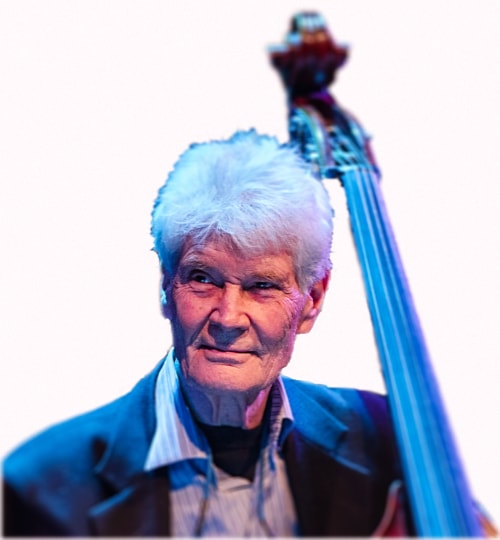
Gene Perla by Dan Wilkins.
Looking back on your career so far, what are the biggest memories and highlights? Having played with Elvin and Miles, there must be some satisfaction on how things turned out?
As a young man probably in my late twenties, I was philosophising about my future and I thought: “If I live to be forty years old, I’ll be okay with that.” When I reached forty, I said to myself: “What I tried to achieve as a player, I did.” I never thought that I would look back at the roster of people that I played with. It’s certainly gratifying. The thrill of being able to interact with Elvin Jones and Don Alias is a very special thing for me.
What are your plans for the future?
I sold the PM Records label in 2024, but I’m still interested in producing and assuming that I continue that, I’d just be ferrying those projects to the new owner.
I’m still interested in teaching because it’s financially helpful and I love interacting with the young-up-and-comers. I have my health; I have my energy. I can still play pretty well, so I’ll keep going.
Many thanks to Gene for all his help, time and patience, and for providing several images. His website is at perla.org.